
If you own land anywhere in New Zealand, you know that finding the right gorse spraying company is your first real step towards dealing with one of our most stubborn weeds. Getting it right means bringing in professionals who offer precision, care, and a solid long-term plan—especially on the rough country where gorse loves to grow. This guide will help you make a smart choice and find the right partner to reclaim your land.
Tackling New Zealand’s Toughest Weed with Precision
For farmers, foresters, and lifestyle block owners across the North Island, gorse isn’t just a prickly nuisance. It’s a constant drain on your bottom line and the health of your land, choking out good pasture and smothering native bush. This invasive weed presents a unique challenge on our rugged terrain, where steep gullies, protected waterways, and dense thickets make spraying a nightmare with traditional gear. Many landowners have found that old-school ground spraying or broad aerial passes just don’t cut it, lacking the pinpoint accuracy needed to do the job properly.
This guide moves beyond generic advice to help you select a gorse spraying company that truly fits your property and your goals. To win this battle, you need to understand the modern tools available. We’ll explore how newer approaches, especially drone technology, offer a smarter, more efficient, and far more environmentally friendly way to manage this tough weed. Think of this as your practical handbook for taking back your land, with a focus on doing it right.
The Scale of the Gorse Problem
The gorse problem is woven into New Zealand’s history. Originally introduced in the 19th century for hedges, it quickly escaped and ran wild. Today, it covers a staggering 900,000 hectares, which is about 3.6% of the country’s entire land area. Even back in the early 1980s, it had already claimed 700,000 hectares. That makes it one of our most infamous agricultural weeds, wiping out valuable pasture and strangling young pine trees in forestry blocks. You can learn more about gorse’s long history in NZ farming on the Preserve Belmont Farm Park site.
This sheer scale shows why we need effective, targeted control. The goal isn’t just to knock back the green you can see; it’s about managing the infestation for good, stopping regrowth, and getting your land productive again. A true professional understands the bigger picture. They don’t just show up with a sprayer; they bring the expertise to apply the right chemical with surgical precision, hitting the gorse hard while protecting everything around it. That targeted approach is what makes the difference between wasting money and making a real investment in your land.
Comparing Gorse Spraying Methods From Ground to Air
Choosing the right way to spray gorse is a big decision for any landowner. It really comes down to a trade-off between access, how precise you need to be, and what you can afford. Every method has its place, from classic ground-based machines to large-scale aerial spraying. Getting your head around the real-world pros and cons of each will help you pick the smartest tool for your block of land.
Ground-Based Boom Spraying
The most familiar option for many farmers is the good old tractor and boom sprayer. It’s a solid choice for flat, easy-to-reach paddocks where a tractor can cruise along without any trouble. It’s straightforward and does the job well on uniform, manageable country. But as we know, much of the North Island landscape is anything but flat. That’s where tractors hit their limits. They’re no use on steep hillsides, in soggy gullies, or across the boggy ground where gorse thrives. Furthermore, the weight of the machinery going over the same ground again and again can cause serious soil compaction, which harms your pasture and drainage. It’s often not practical for the very spots where gorse is the biggest headache.
Large-Scale Aerial Application (Helicopters)
When you’re faced with a massive, hard-to-reach block of gorse, helicopters have traditionally been the answer. A chopper can cover hundreds of hectares in a single day, making it the go-to for big forestry blocks or remote backcountry farms. Speed is its biggest advantage, letting you knock down a huge infestation fast. The flip side is a lack of precision. While great for blanket coverage, a helicopter struggles to hit specific patches of gorse without spraying nearby native bush or good pasture. There’s also a much higher risk of spray drift, particularly on windy days, which means wasted chemical and potential damage where you don’t want it. It’s a powerful tool, but it’s more of a sledgehammer than a scalpel.
The Precision of Drone Spraying
This is where modern drone technology really changes the game, giving you the reach of aerial spraying with a whole new level of accuracy. Drones, or UAVs, get into all the places the other methods can’t. They can fly low and slow over steep, gnarly terrain that’s impossible for a tractor and too fiddly for a helicopter. This allows for incredibly targeted spraying. An operator can pinpoint gorse thickets along stream edges, in awkward gullies, or on sheer bluffs with amazing accuracy. This means less overspray, protecting the plants you want to keep and putting the herbicide exactly where it needs to go. For farmers who need a quality job done with care, this surgical approach delivers better results and is much kinder to the environment.
We’ve got a full breakdown of the different gear out there in our guide on agricultural spraying equipment in New Zealand.
This chart breaks down the thought process landowners often go through when tackling a gorse problem.
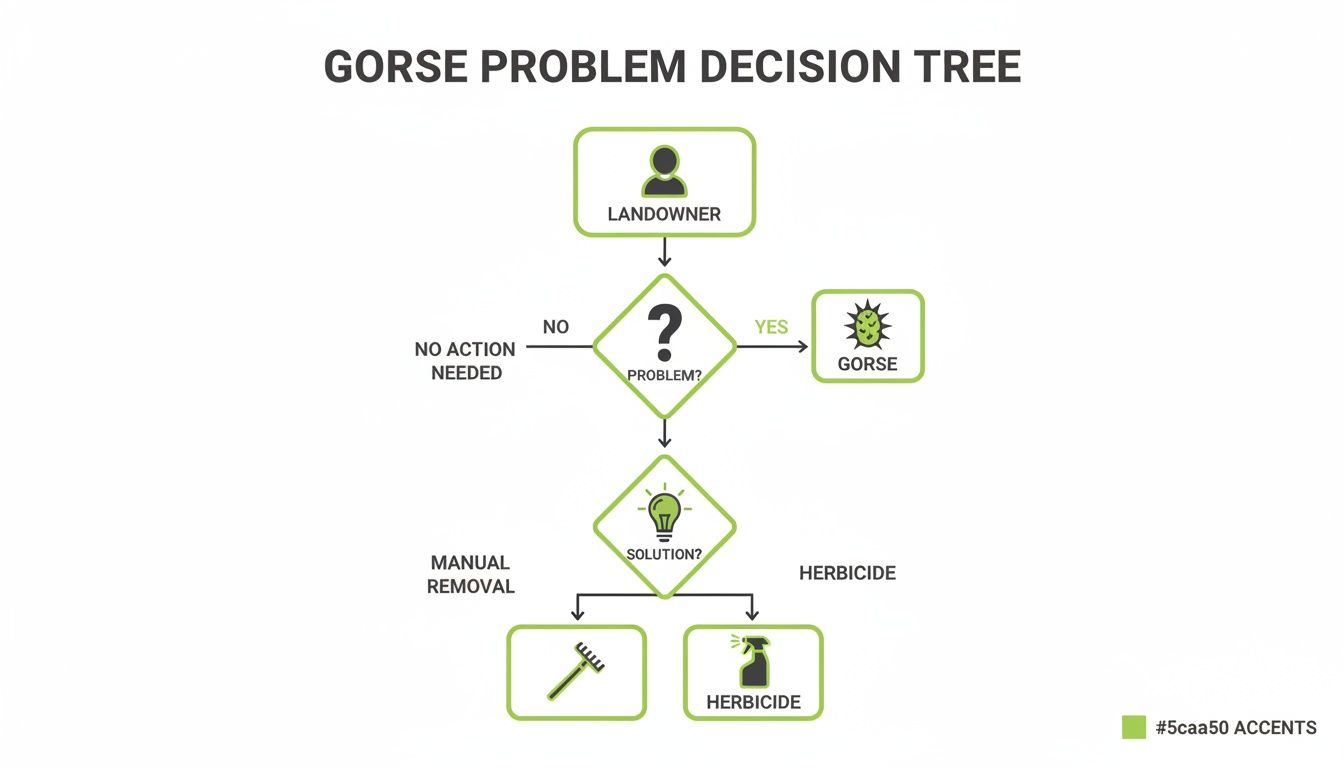
It shows how figuring out the true scale of the issue is always the first step toward finding a solution that will actually last.
Gorse Spraying Methods at a Glance
To make it easier, here’s a quick comparison of the three main gorse spraying techniques. This should help you decide which approach is the best fit for your land and what you’re trying to achieve.
| Method | Best For | Key Advantage | Key Limitation |
|---|---|---|---|
| Boom Spraying | Flat, easily accessible paddocks and uniform infestations. | Cost-effective for simple terrain and straightforward jobs. | Inaccessible on steep or wet ground; causes soil compaction. |
| Helicopter | Vast, remote areas (100s of hectares) needing blanket coverage. | Unmatched speed and ability to cover huge areas quickly. | Lacks precision, high risk of spray drift and off-target damage. |
| Drone Spraying | Steep, difficult-to-access terrain and targeted spot spraying. | Surgical precision, minimal environmental impact, no soil damage. | Slower than helicopters for covering extremely large, open areas. |
Ultimately, the best approach depends entirely on your situation. The choice isn’t just about the tech—it’s about finding the most efficient, cost-effective, and responsible way to take back your land from gorse.
Why Drone Spraying Is a Game Changer for Gorse Control
When it comes to gorse, we’ve moved well beyond the old ways of doing things. Drone spraying isn’t just a new gadget in the toolbox; it’s a massive leap forward in how we manage infestations, offering better results with far more care and precision. For farmers and landowners across New Zealand, especially in the tricky terrain around Auckland and Waikato, drones are a practical answer to problems that have made effective gorse control a headache for years.
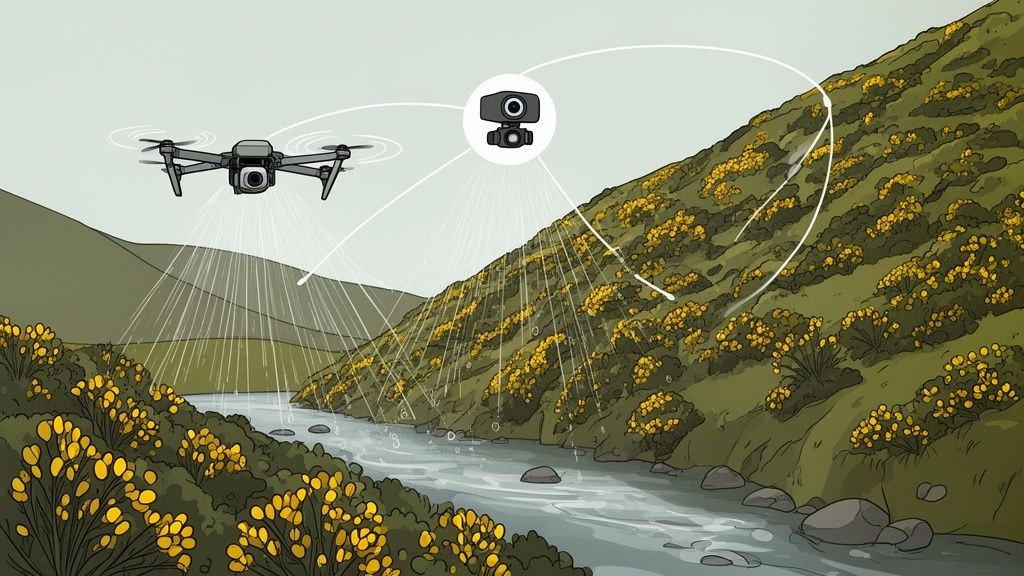
The real advantage is their ability to get into places other machines simply can’t. Think of those steep, slippery hillsides, tight gullies, or the protected margins along waterways where gorse loves to dig in but a tractor can’t safely go. Drones navigate these spots with ease, providing access to every awkward nook and cranny that was previously out of reach. That complete access is key to achieving proper control, not just knocking back the easy-to-reach patches, and allows for much faster application than traditional methods in these areas.
Unmatched Precision and Efficiency
One of the biggest wins with drones is their surgical accuracy. With intelligent flight controls and real-time imaging, a skilled operator can target individual gorse bushes or dense thickets with pinpoint precision. This targeted approach massively cuts down the risk of spray drifting where it shouldn’t, protecting your good pasture, native bush, and sensitive waterways.
This precision brings some very real benefits:
- Reduced Chemical Use: When you put the herbicide exactly where it’s needed, you use less of it. This lowers your costs and is better for the land.
- Consistent Coverage: Drones deliver a uniform spray from the perfect height and speed. This ensures every part of the plant gets treated properly for a much better knockdown.
- Protection of Surrounding Areas: We can create exact digital boundaries for a spray job. That means we can work right up to a fence line or a stream without worrying about overspray.
By focusing the application directly onto the gorse, drone technology ensures a more effective kill while safeguarding the health of the surrounding land. You just can’t get that level of care with broad-scale aerial methods.
This targeted approach is a world away from decades of broader efforts. Since the 1920s, New Zealand has tried biological controls like seed-feeding insects, but they’ve never been the whole solution. It’s clear that an integrated approach is needed, and precision drone spraying fills a critical gap. It allows for effective chemical application without the widespread environmental risks of less accurate methods. You can learn more about these early efforts in this research on biological gorse control.
Operational Advantages for Modern Farming
Beyond accuracy, drone spraying companies offer real operational benefits that fit the pace of modern farming. Being able to deploy quickly is a huge plus, letting us jump on ideal weather windows without any delay. And unlike heavy gear, drones can often get to work on wet ground where a tractor would get bogged or tear up the paddock. That brings up another key point: zero soil compaction. Driving heavy tractors over your land again and again damages the soil structure, leading to poor drainage and weak pasture growth. Drones fly, leaving your ground completely untouched. This is vital for keeping your valuable soil healthy and productive. For farmers who need a fast, efficient, and careful way to handle weeds, drones deliver on all fronts. This technology allows gorse spraying companies to offer a higher standard of service, which means better long-term results for your property.
How to Choose the Right Gorse Spraying Partner
Picking the right gorse spraying company is a big deal for the long-term health of your land. This isn’t just about hiring someone to spray a chemical; it’s about finding a professional partner who understands your property, uses the best gear with precision, and is committed to doing the job safely and effectively. Making a smart choice now means you’re investing in a real solution, not just kicking the can down the road.
When you start your search, you need to look beyond the number on a quote. A good partner brings expertise that goes way beyond just running the machine. They should act more like a consultant, helping you map out a strategy that fits your specific terrain and environmental needs, especially in sensitive spots around Waikato and Auckland. A quality operator won’t just offer a generic service—they’ll tailor their approach to your land’s unique challenges.
Checking Credentials and Experience
First things first, you need to see proof they know what they’re doing. Don’t be shy about asking a potential contractor for their qualifications and track record. Any reputable operator will be upfront about their certifications and happy to show you.
Key things to ask about include:
- Pilot Certification: If they offer drone spraying, make sure the operator holds the necessary Civil Aviation Authority (CAA) certifications, like the Part 102 certificate required for commercial drone operations in New Zealand.
- Chemical Handling Qualifications: Anyone spraying agricultural chemicals must be properly certified. This proves they understand the products, application rates, and all the safety rules.
- Relevant Experience: Ask about their experience with gorse, especially on land like yours. A company that’s successfully treated steep hill country has the hands-on skills needed for tough jobs.
This isn’t just about ticking boxes; it’s about ensuring safety and quality. An experienced, certified operator knows how to get the best results while minimising risks to people, stock, and the local environment.
Understanding Their Technology and Approach
Beyond the paperwork, the gear a company uses tells you a lot about their commitment to a high-quality, precise job. For those hard-to-reach gorse infestations, a company with modern drone technology has a massive advantage. Ask them about the specific drones they use, like the advanced DJI AGRAS models, and how their features will benefit your property. A data-driven approach is what separates the pros from the amateurs. Top-tier gorse spraying companies don’t just guess; they use mapping software and GPS to plan flight paths for complete and accurate coverage. This makes sure no patches are missed and prevents over-spraying, which saves you money and protects your land.
A partner focused on a tailored strategy uses technology not just to spray, but to gather data and deliver a precise, repeatable, and verifiable service. This level of care and precision is what separates the experts from the rest.
Evaluating Quotes and Service Inclusions
When you get a quote, it should be clear, detailed, and transparent. A vague quote can hide unexpected costs later on. Look for a breakdown that explains exactly what you’re paying for, so you can compare offers properly and make a confident decision.
A comprehensive quote should clearly outline:
- Chemical Costs: The type of herbicide they plan to use and its cost per litre or hectare.
- Application Rates: The volume of the chemical mix to be applied per hectare.
- Service Area: A clear definition, often with a map, showing the exact area to be treated.
- Total Cost: A final price that includes all labour, travel, and materials.
This level of detail shows professionalism and helps you see the true value you’re getting. You can learn more about the team and philosophy behind this detailed approach by reading about our mission on the AgriUAS about us page. Ultimately, choosing the right partner is about finding a company that invests in the quality, safety, and long-term success of your gorse control programme.
Planning Your Strategy for Lasting Gorse Control
Winning the battle against gorse isn’t about a single spray day; it’s about having a long-term game plan. Gorse is an incredibly tough weed, and a one-off treatment is usually just a temporary fix. A truly successful control programme comes down to smart timing, realistic expectations, and a multi-year commitment to finally reclaiming your land. When you work with a professional gorse spraying company, you can build a strategy that delivers lasting results, not just a short-term knockdown.
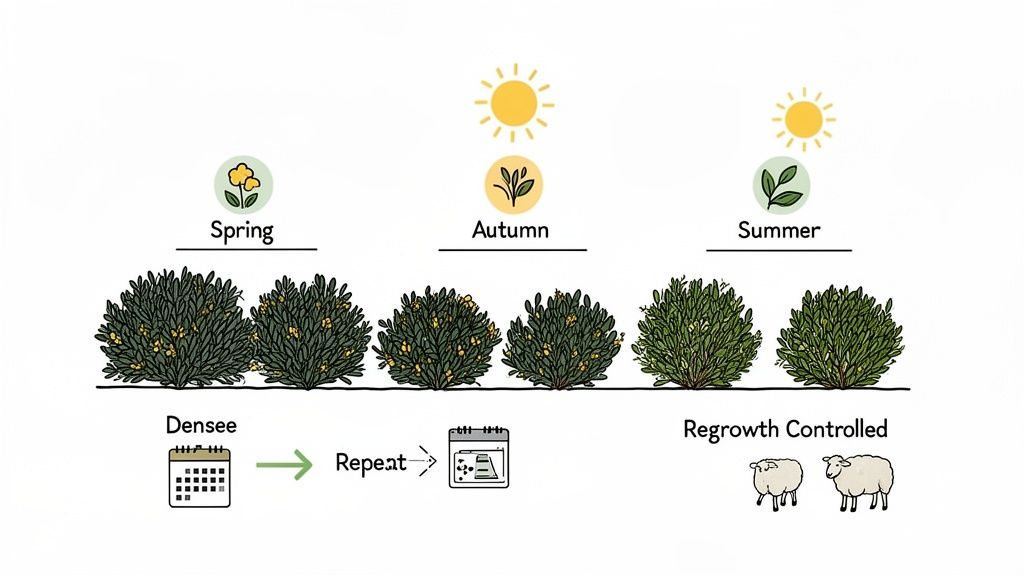
That first application is just the beginning. To get the most out of it, timing is absolutely everything. You need to spray when the gorse is actively growing, as this is when the plant will properly absorb the herbicide and pull it right down into its root system.
Timing Your Gorse Treatment for Maximum Impact
For most of the North Island, the ideal windows for spraying line up with the main growing seasons. Hitting it then ensures the plant is vulnerable and the treatment will be as effective as possible.
The two key seasons are:
- Spring (September to November): As things warm up, gorse explodes with fresh, soft growth. This new foliage is far more receptive to herbicide than the tough, woody growth on older plants.
- Autumn (March to May): At this time of year, the plant is busy sending energy down to its roots to prepare for winter. Spraying now means the herbicide gets drawn deep into the root system, delivering a much more thorough kill.
Trying to spray outside these periods, especially in the dead of summer or the cold of winter, can yield poor results. A good contractor will always give you solid advice on the best timing for your specific property and the state of your gorse.
Addressing the Persistent Seed Bank
One of the biggest headaches with gorse is its incredibly long-lived seed bank. A single bush can drop thousands of seeds that can stay viable in the soil for up to 50 years. After the initial spray clears the mature plants, you can bet those dormant seeds will start to germinate, bringing a fresh wave of regrowth.
Effective gorse management is a marathon, not a sprint. The real win comes from consistently managing regrowth until the seed bank is depleted, and that takes a dedicated follow-up plan.
This is where a multi-year strategy is non-negotiable. Your initial spray is about tackling the existing problem, but every treatment after that is about stopping a new one from taking hold. Follow-up spot spraying—often done with drones for pinpoint accuracy—is crucial for knocking over these new seedlings before they get a chance to grow up and drop more seed.
Integrating Land Management for Lasting Success
Chemical control is only one piece of the puzzle. Real, long-term success comes from combining spraying with smart land management. Once the gorse is cleared, the goal is to get a competitive pasture or native cover established to outcompete any new gorse seedlings that pop up. This isn’t a new idea; it’s an approach that’s been used across New Zealand for decades. For example, farmer-led groups in places like the Wairarapa have been working on co-operative gorse control tactics since the 1980s. Their trials proved that mob-stocking cleared areas with sheep at high densities could effectively crush and kill a high percentage of gorse seedlings—a technique that works perfectly alongside an initial spray programme. This long-standing war against what Massey University experts call our ‘worst scrub’ shows just how important a combined approach is for taking back valuable grazing land. You can read more about these historic farmer-led efforts in the NZ Grassland Association Journal.
By pairing well-timed spraying with strategic grazing and pasture improvement, you create an environment where gorse simply struggles to get a foothold. The right gorse spraying partner will help you build this kind of comprehensive plan, putting you on a clear path to getting your land back for good.
Take the Next Step to Reclaim Your Land From Gorse
Gorse is a tough opponent, no doubt about it. But as we’ve covered, modern technology and the right partners make winning the battle more achievable than ever. Getting on top of this invasive weed really boils down to two things: understanding your options and committing to a smart, long-term plan. The right approach won’t just clear the gorse—it will transform your land, bringing back its health and productivity for years to come.
We’ve seen how precision drone spraying really shines, especially on the challenging terrain we see so often across the North Island. Its ability to get into steep gullies, reduce chemical use with targeted application, and get the job done efficiently makes it a powerful tool for any landowner. Now it’s time to put that knowledge into action.
From Knowledge to Action
The single most important step you can take is to get a professional to walk your property. Every block of land is different. You might have steep banks, sensitive waterways, or a particularly dense patch of gorse that needs a specific approach. A generic, one-size-fits-all solution just doesn’t cut it for lasting results.
An on-site evaluation with an experienced operator gives you:
- A clear understanding of just how big your gorse problem is.
- Expert recommendations on the best treatment methods for your specific piece of land.
- A tailored strategy covering the right timing, chemical mix, and a follow-up plan to tackle regrowth.
Moving from reading about it to actually doing it starts with one decisive step. A site-specific evaluation is the foundation of any effective gorse control programme, making sure every decision is based on the reality of your land.
This initial chat is invaluable. It’s your chance to ask questions, talk about what you want to achieve with the property, and get a realistic picture of the timeline and results. Choosing the right gorse spraying companies means finding a partner who will work with you, protecting your investment and restoring your land’s value.
Request Your Professional Assessment
Taking back your land from gorse is a big job, but it’s absolutely worth it. The process starts with getting accurate, expert advice that’s specific to your situation. We encourage you to start the process of reclaiming your land and restoring its productivity. To start your journey towards a gorse-free property, the next step is to get in touch for a detailed quote and a site-specific evaluation. You can learn more about how to do this by visiting our contact page to request your quote from AgriUAS.
Frequently Asked Questions About Gorse Spraying
Deciding to bring in the professionals for gorse control is a big step, and it’s smart to have questions. Getting the right information is key to reclaiming your land for good. Here are some of the most common queries we get from farmers and landowners across the North Island.
How Long Does It Take to See Results After Spraying?
You won’t see gorse disappear the day after we spray. The herbicide has to soak into the plant and make its way down to the roots to do its job properly. Typically, you’ll start to see the foliage yellowing and browning within two to four weeks. This timeframe can change a bit depending on the chemical used and the time of year. The full die-off can take several months as the plant is killed from the roots up. It’s a marathon, not a sprint—a slow, thorough kill is far better than a quick browning of the leaves.
What Is the Best Time of Year to Spray Gorse?
Timing is everything when it comes to effective gorse control. We get the best results when the plant is actively growing because that’s when it absorbs the herbicide most effectively. For most of the North Island, this gives us two main windows:
- Spring (September – November): The gorse is full of fresh, soft growth that’s prime for absorbing the treatment.
- Autumn (March – May): The plant is busy sending nutrients down to its roots for the winter, and it takes the herbicide along for the ride.
We generally avoid spraying in the peak of summer heat or the dead of winter, as it’s far less effective and not what professional gorse spraying companies would recommend.
Is One Spray Treatment Enough to Control Gorse?
Almost never. Gorse is incredibly stubborn, mainly because of its seed bank. Those seeds can sit dormant in the soil for up to 50 years, just waiting for their chance. A single spray might knock down the mature plants, but that just clears the way for a new generation of seeds to sprout.
Effective gorse control is a long-term commitment. Think of the first spray as the initial big push. After that, a multi-year plan with follow-up spot spraying is essential to tackle regrowth and wear down that seed bank over time.
This follow-up work is what makes the difference between a temporary fix and lasting control.
Can Drones Spray in Wet or Windy Conditions?
Drones give us a lot more flexibility, but we still have to respect the weather. One of the big advantages is that we can work over damp ground without churning up your paddocks. However, we can’t fly in heavy rain because it would simply wash the herbicide off the plants before it has a chance to work. Wind is another major factor. To prevent spray drift and ensure the chemical goes exactly where it’s meant to, we don’t fly in high winds. Professional operators stick to strict guidelines and only operate when conditions are right for a safe and effective job.
How Much Does Professional Gorse Spraying Cost?
The cost can vary quite a bit. It really depends on the size of the area, how thick the gorse is, the steepness of the terrain, and which application method we use. Any professional quote should give you a clear breakdown of chemical costs, application rates, and labour. While it’s certainly an investment, getting it done professionally means the job is done right—with precision, the correct compliance, and care. In the long run, this delivers far better value and more permanent results than trying to tackle it yourself.
Ready to take the first step towards getting your property back from gorse? The team at AgriUAS Limited provides expert, data-driven drone spraying solutions designed specifically for your land. Contact us today for a site-specific evaluation and a detailed quote.