
Gorse is more than an eyesore on the farm; it’s a relentless threat to land productivity and property value across New Zealand. We understand the unique challenges Kiwi farmers face with this invasive weed, which is why this guide offers practical, field-tested strategies to bring it under control. We focus on achieving quality results with modern, precise solutions like drone spraying, ensuring every application is performed with the utmost care.
Why Gorse Control Is a National Priority
Gorse (Ulex europaeus) is an incredibly tough and aggressive weed, perfectly suited to thrive in New Zealand’s climate. Originally introduced as a hedge plant, it quickly escaped cultivation to become one of our most costly agricultural pests. For farmers and landowners, an unchecked gorse infestation means more than just an untidy property. It directly impacts your bottom line by shrinking usable grazing land and consuming significant time and resources to manage. Its ability to form dense, impenetrable thickets chokes out valuable pasture and native bush, diminishing the value of your land.
The Financial and Environmental Cost
The significant economic cost of gorse is not a new issue. Back in the early 1980s, it had already been identified as New Zealand’s most expensive weed to manage, with control costs estimated at $22 million annually. That staggering figure highlighted the scale of the problem, with gorse having already taken over approximately 900,000 hectares of land. To understand the broader context, you can learn more about the history of farming challenges in our country. This long-running battle underscores the need for efficient, precise, and effective control methods.
Gorse’s resilience is legendary. A single mature plant can produce thousands of seeds a year, and those seeds can lie dormant in the soil for up to 30 years, awaiting the right conditions to sprout. This long-term seed bank is precisely why a one-off spray is never a complete solution.
Modern Solutions for a Persistent Problem
Controlling gorse effectively requires a smart, multi-faceted plan. While traditional ground-based spraying has its applications, it often falls short on the steep hills, deep gullies, and boggy paddocks common on New Zealand farms. This is where modern technology provides a clear advantage. Drone spraying delivers a solution that is not only effective but also aligns with the principles of quality and precision. The benefits for farmers are clear: drones can access areas conventional spraying can’t reach, they offer unparalleled speed of application, and their ability to target specific areas minimises waste and protects surrounding pasture. This guide provides actionable advice for spraying gorse nz, helping you build a sustainable management plan to reclaim your land with confidence.
Timing Your Gorse Spraying for Maximum Impact
When it comes to effective gorse control, timing is everything. Hitting the plant at the right stage of its growth cycle is the single most important factor in achieving a high kill rate and ensuring your investment delivers results. Spraying at the wrong time of year leads to poor outcomes, wastes expensive chemicals, and allows the gorse to recover quickly. The key is to apply herbicide when the gorse is actively growing. During these periods, the plant’s sap flows strongly, which is essential for carrying the herbicide from the leaves down to the root system. This systemic action is what kills the entire plant, not just the foliage. In New Zealand, this gives us two main windows for optimal application: spring and autumn.
Aligning Spraying with Gorse Growth Cycles
In spring, immediately following the main burst of yellow flowers, gorse produces a flush of soft new growth. This is an ideal time for spraying. The plant is actively absorbing nutrients to fuel its expansion, so any herbicide applied is circulated rapidly throughout the plant, delivering a decisive blow. Autumn presents another prime opportunity. As the weather cools, gorse begins to transfer its energy reserves from the leaves down into its roots in preparation for winter. Spraying at this time cleverly uses this natural process, ensuring the herbicide is transported directly to the root crown for a more permanent kill.
Optimal Gorse Spraying Calendar for New Zealand Conditions
To achieve the best results, it’s helpful to understand the gorse growth cycle across the seasons. This calendar outlines the ideal times for spraying and explains what the plant is doing throughout the year, allowing you to plan with precision.
| Season | Gorse Growth Stage | Spraying Efficacy | Key Considerations for Farmers |
|---|---|---|---|
| Spring (Sept-Nov) | Active Growth. Flush of soft new foliage after flowering. | Excellent. Plant is actively taking up nutrients and sap flow is strong. | Ideal for targeting regrowth and seedlings. A key window for reclaiming pasture. |
| Summer (Dec-Feb) | Hardened & Stressed. Plant may become dormant in hot, dry conditions. | Poor. Herbicide uptake is significantly reduced. Foliage is tough. | Avoid spraying during heatwaves or drought. Results will be disappointing. |
| Autumn (Mar-May) | Active Growth. Translocating energy down to the roots for winter. | Excellent. Herbicide is drawn down into the root system, ensuring a total kill. | Great for tackling steep or wet areas with drones before winter sets in. |
| Winter (Jun-Aug) | Dormant. Minimal growth and very slow sap flow. | Poor to Very Poor. The plant isn’t moving chemicals effectively. | Not a recommended time for spraying. Focus on planning and machinery maintenance. |
By focusing your efforts within the active growth windows of spring and autumn, you set yourself up for success and ensure your resources are used effectively.
It’s a common mistake to assume that if gorse is green, it’s good to spray. You must target the plant when it’s actively growing in spring and autumn. Spraying dormant gorse in winter or drought-stressed gorse in summer is often a complete waste of time and money.
This timeline shows just how far we’ve come, from gorse being a massive economic headache in the 80s to the high-tech drone solutions we have today.
Technology has given us much smarter, more precise ways to tackle what has been a long-running battle for Kiwi farmers.
Why Summer and Winter Spraying Just Doesn’t Cut It
Attempting to spray gorse in the middle of a Waikato summer or the depths of a Southland winter is generally a losing battle. During hot, dry weather, gorse shuts down to conserve water, and its hardened leaves do not absorb chemicals well. In winter, the plant is largely dormant, so the sap flow required to transport the herbicide to the roots is minimal. While it might feel productive to spray whenever you have a spare afternoon, you will achieve far better results by working with the plant’s biology. This considered approach ensures that the care and resources you invest produce the desired outcome.
Our history with gorse control in New Zealand shows how vital it is to understand local conditions. For example, the gorse seed weevil was introduced as a biocontrol but had limited success. The weevil is active only in spring, but our gorse has a unique double-flowering cycle in both spring and autumn. This mismatch highlights why spraying gorse in NZ must be timed perfectly to coincide with these distinct active periods. You can read more facts about gorse’s unique traits in New Zealand to better appreciate why local knowledge is essential.
Working Spraying into Your Farm Calendar
For the best long-term results, consider how your gorse spraying integrates with your overall farm management plan. A little planning can transform a reactive chore into a strategic part of your farm’s improvement. Here are a few practical scenarios for farmers: hitting the vulnerable regrowth after mechanical clearing, spraying a paddock before re-sowing to give new pasture the best start, or using drones to treat wet gullies in autumn when ground access is impossible. By thinking strategically about your timing, you stop merely managing gorse and start actively reclaiming your land. A well-timed spray doesn’t just kill a weed; it clears the way for more productive pasture and a healthier farm.
Choosing the Right Herbicide and Application Method
Once you have determined the optimal timing, the next critical decision involves selecting the right tools for the job. This means choosing an effective herbicide and pairing it with the best application method for your specific property. Getting this right ensures every dollar you spend works efficiently to reclaim your pasture. An incorrect choice can lead to poor results, wasted chemicals, and potential damage to valuable grass. The goal is not just to kill the gorse but to do so with precision, protecting your pasture and setting the stage for long-term productivity.
Selecting the Right Herbicide for Gorse
In New Zealand, a few well-tested active ingredients are highly effective against gorse. The two you will encounter most often are metsulfuron-methyl and triclopyr. Understanding their properties helps you make an informed decision for your situation. A key requirement for most farmers is selecting a herbicide that is pasture-safe. There is little point in eliminating gorse if you destroy your valuable grass in the process. A thick, healthy pasture is your best natural defence against the next wave of gorse seedlings, as it outcompetes them for light and nutrients. Leaving behind bare ground only invites more weeds to establish.
Contrasting Application Methods
How you apply the chemical to the plant is just as crucial as the chemical itself. For years, we have relied on ground-based methods, but new technology is transforming the approach to weed control. While traditional methods like knapsacks or boom sprayers still have a place for small, easily accessible patches, they have serious limitations on typical New Zealand hill country. Achieving good coverage on dense, prickly gorse is difficult, and accessing steep, slippery hillsides or wet gullies with vehicles is often impractical or unsafe. This is where the advantage of modern drone technology becomes clear.
Choosing the right application method is about balancing accessibility, precision, and efficiency. On the varied and often challenging terrain of a New Zealand farm, what works for a flat paddock simply won’t work for a steep gully.
The Drone Spraying Advantage
Drone technology offers a significant leap forward, providing a solution to many of the challenges posed by traditional methods. It brings a new level of precision and care to spraying gorse in NZ. Drones are masters of difficult terrain. Steep, hazardous hillsides and boggy gullies that are inaccessible to vehicles are easily and safely managed from the air. This capability allows farmers to implement effective control strategies across their entire property, not just the easy-to-reach areas. The practical benefits are substantial: targeted application reduces overspray, protects pasture and waterways, and covers large areas quickly and efficiently, making the whole operation more effective.
Precision Application for Superior Results
The true strength of drone technology lies in its precision. We program our drones to fly exact paths, applying a consistent, even coat of spray precisely where it is needed. This targeted approach pays dividends in several ways. The controlled flight path and the powerful downdraft from the drone’s rotors push the spray directly into the gorse, significantly reducing the risk of chemical drifting onto desirable pasture, native bush, or waterways. This same downdraft ensures optimal coverage by forcing the spray deep into the gorse canopy, reaching inner stems that ground-based methods often miss. This thorough application is vital for a complete kill. By delivering the herbicide exactly where it is needed, drone spraying saves money, protects your land, and delivers a superior, quality result. If you’re weighing up your options, our guide on agricultural spraying equipment in NZ dives deeper into the different technologies available.
The Drone Advantage for Hard-to-Reach Gorse
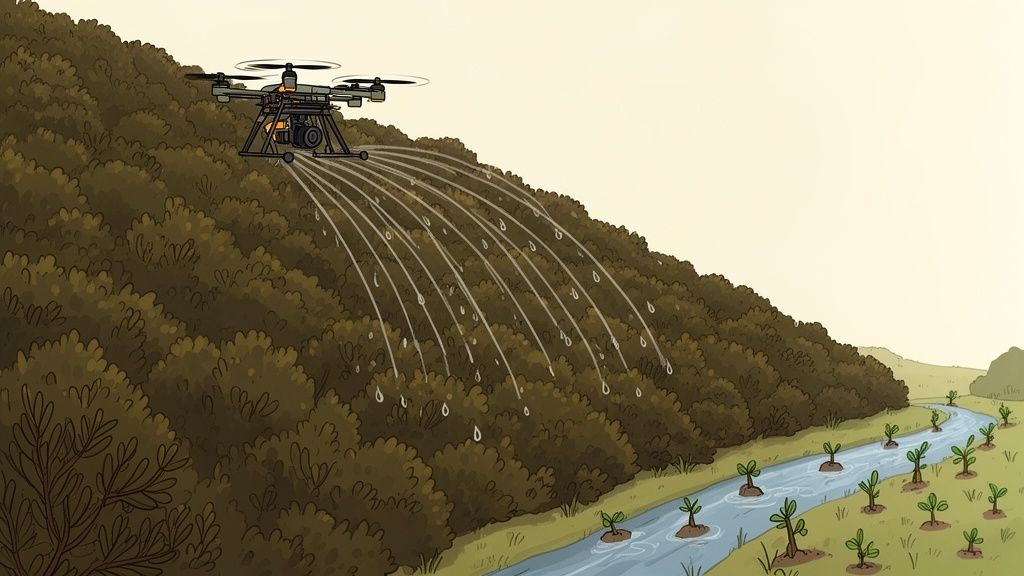
Every New Zealand farm has those challenging spots—the steep, slippery hillsides, deep gorse-choked gullies, and boggy corners where a tractor or quad bike cannot safely go. For years, these areas have served as gorse strongholds, allowing seeds to spread across more accessible land. Traditional ground-based spraying is often inefficient, exhausting, and hazardous in such terrain. This is precisely where drone technology provides a transformative solution for spraying gorse in NZ, enabling farmers to manage their entire property with a new level of quality and precision.
Unlocking Inaccessible Terrain
The most significant advantage of using drones for gorse control is their ability to access areas that other equipment cannot. Steep faces that pose a serious health and safety risk for a ground crew are treated easily and safely from the air. This capability opens up large sections of land that may have been previously written off as “too hard.” By targeting gorse in these unreachable locations, you can finally break the cycle of re-infestation and begin the process of reclaiming your entire property, not just the easily managed parts. For farmers, this means turning unproductive, weed-infested land back into a valuable asset.
Speed and Efficiency on a New Scale
Beyond just access, drones offer incredible speed and efficiency. A professional drone system can cover difficult terrain far more rapidly than any ground-based method. This rapid deployment allows us to treat large areas quickly, making the most of the tight weather windows that are a constant reality in New Zealand farming. For a farmer, this efficiency translates to less operational downtime and a faster return to productive pasture. Instead of a multi-day effort with a spray hose, the job can often be completed in a matter of hours, delivering better, more consistent results.
Drone spraying isn’t just about flying over the gorse. It’s about applying the right amount of chemical, with precision, to terrain that was previously impossible to manage effectively. It turns a problem area into a productive asset.
This combination of speed and access is crucial for tackling common challenges on the farm. Drones can safely apply herbicide to hillsides too dangerous for ground crews, manage boggy gullies without causing soil damage, and precisely treat gorse along sensitive stream banks and waterways where careful application is paramount.
Precision Application with Zero Soil Compaction
One of the often-overlooked benefits of drone spraying is what it doesn’t do. Unlike heavy machinery, drones have zero impact on the ground. This means no soil compaction, no rutting of wet pasture, and no damage to the very land you are trying to improve. This is a significant advantage, particularly in spring and autumn when soils are often soft. Furthermore, the drone’s surgical precision is a major asset. We can program flight paths to follow a fenceline exactly, spray an isolated patch of gorse in a paddock without touching the surrounding clover, or work carefully around protected native bush. This level of control minimises off-target damage and ensures every drop of chemical is used effectively.
Achieving Superior Canopy Penetration
The design of a modern spraying drone provides another powerful advantage. The rotors generate a strong downdraft, known as rotor wash, which actively forces the fine spray droplets deep into the dense, tangled gorse canopy. This is critical for achieving a complete kill. Ground-based methods often only coat the outer leaves, failing to reach the inner stems. The drone’s downdraft ensures total coverage, forcing the herbicide into the heart of the plant for a much more effective result. It is this combination of advanced technology and careful technique that delivers a quality outcome, every time.
Building a Long-Term Gorse Management Plan
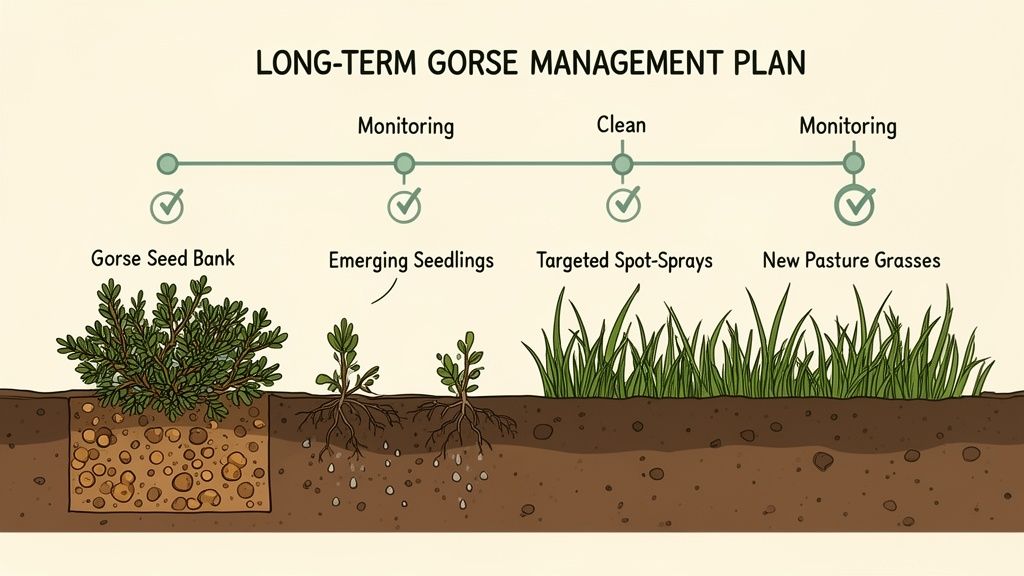
Winning the battle against gorse requires more than a single spray; it demands a commitment to a long-term strategy. As any farmer who has dealt with this weed knows, a one-off application might clear a hillside for a season, but the real challenge lies dormant in the soil. A massive seed bank is simply waiting for its chance to germinate. Successfully reclaiming your land means thinking years ahead. The initial large-scale spray is just the first step in a continuous process of management and care.
The persistence of gorse is well-documented. A single mature plant can drop thousands of seeds, which can remain viable in the soil for decades. This is why a “spray and walk away” approach to spraying gorse in NZ is guaranteed to fail. The real work begins after the initial knockdown, focusing on preventing the next generation from taking hold.
Monitoring and Follow-Up Treatments
After your initial broadcast spray, it is crucial to regularly walk the treated areas. Keep a sharp eye out for the inevitable flush of new seedlings that will emerge, especially following rain. These young plants are your next target. Addressing them early is far easier and more cost-effective than allowing them to establish and produce seeds of their own. Plan for timely follow-up spot treatments. Small seedlings are extremely vulnerable and can be managed efficiently with a knapsack or a highly targeted drone application. This proactive approach prevents a new generation of gorse from establishing, ensuring your initial investment continues to pay dividends.
Integrating Spraying with Smart Land Management
Chemical control is just one tool in your arsenal. The most effective long-term plans integrate spraying with sound land management practices. The ultimate goal is to create an environment where desirable species outcompete gorse. A dense, healthy pasture is your greatest ally in this effort. By oversowing treated areas with competitive grass and clover species, you establish a thick sward that shades out emerging gorse seedlings, starving them of the light they need to survive. This approach effectively transforms your pasture into a living barrier against re-infestation.
This integrated strategy is essential because chemical control alone has its limitations. Research has shown that gorse seeds can stay dormant for up to 50 years. This incredible persistence makes it clear why a multi-faceted plan is the only path to long-term success.
A successful gorse management plan isn’t just about killing the plants you can see. It’s about changing the environment to make it inhospitable for future generations. The goal is to foster a landscape where productive pasture outcompetes gorse at every turn.
By combining precise initial spraying with diligent follow-up and smart pasture management, you can permanently restore your land’s productivity and value. If you need assistance with any part of this process, our expert weed spraying services are designed to support every stage of your long-term plan, ensuring a quality outcome for your farm.
Team Up with AgriUAS for Smarter Gorse Control
Reclaiming your land from gorse requires a smart, targeted plan executed with precision and care. Our advanced drone technology transforms a tough, labour-intensive job into a straightforward and effective operation. We focus on delivering quality results by accessing those challenging areas that traditional methods simply cannot reach. Our drones are designed for the demanding terrain found on New Zealand farms. From steep, slippery hillsides to boggy gullies, we can operate safely and apply treatments efficiently, targeting dense gorse infestations with pinpoint accuracy. This precision means less spray is wasted, soil compaction from heavy machinery is eliminated, and your valuable pasture and native bush are protected.
More Than Just Spraying – We’re Your Partner on the Land
We are more than just a spray provider; we view ourselves as a strategic partner dedicated to restoring your land to its full potential. We understand the challenges farmers face and are focused on delivering lasting results. Our process begins with a conversation to understand your property’s specific needs and your long-term goals. For farmers and landowners across Auckland, Waikato, and the wider North Island, we offer a superior approach to gorse control. The practical benefits for your operation are clear: we can access any terrain, our technology ensures precise application, we work quickly to fit within tight weather windows, and our method achieves better canopy penetration for a more effective kill.
Ready to clear your land for good? Choosing AgriUAS is an investment in a quality, long-term solution for your gorse problem. The first step is a conversation. To find out more or to get a customised assessment and quote for your property, contact our team today and let’s get it sorted.
Gorse Spraying FAQs
When it comes to gorse control, we receive many of the same questions from farmers and landowners. Here are our answers to the most common queries, providing clear, practical information to help you plan.
How Long Does Gorse Take to Die After Spraying?
Patience is key, as the time it takes for gorse to die back completely depends on the herbicide used, the time of year, and the plant’s health. When using a systemic herbicide like metsulfuron-methyl, the process is thorough but not immediate. You may notice the first signs of yellowing or leaf drop within a few weeks, but achieving a full kill can take 2 to 3 months. This timeframe allows the chemical to circulate fully through the plant and down to the root system. While faster-acting herbicides might brown the foliage more quickly, the ultimate goal is always a complete kill of the entire plant, not just a superficial burn.
Is Drone Spraying More Expensive Than Traditional Methods?
While the initial quote for drone spraying might appear higher, it often proves to be more cost-effective when you consider the overall picture. Traditional methods come with hidden costs, including the long hours required for manual labour in difficult terrain, fuel consumption, and the significant safety risks associated with operating on steep or unstable ground. Drones address these issues directly. They cover challenging areas faster and more safely. Their precision also minimises chemical waste, ensuring every dollar you invest in herbicide hits its target. When you factor in the value of finally treating those previously inaccessible areas, drone spraying emerges as a smart investment in your land’s future productivity.
The real value of drone spraying isn’t just in the cost per litre; it’s in the efficiency, safety, and superior results achieved on challenging terrain that would otherwise remain untreated and unproductive.
What Should I Do with the Land After the Gorse Is Dead?
Once the gorse is dead and begins to break down, your next priority is to establish competition in the soil. Leaving bare earth creates an open invitation for a new wave of gorse seedlings to germinate from the existing seed bank. The most effective strategy is to oversow the area with a vigorous pasture mix as soon as conditions allow. A thick, healthy sward of grass and clover will quickly cover the ground, shading out any emerging gorse seedlings and preventing them from re-establishing. This final step is crucial for converting cleared land back into a productive, long-term asset for your farm.
Can You Safely Spray Gorse Near Waterways or Native Bush?
Yes, absolutely. Protecting sensitive areas such as streams, wetlands, and native bush is a top priority, and this is where the precision of a professional drone service offers a significant advantage for spraying gorse in NZ. Our drones operate on pre-programmed GPS flight paths that include carefully mapped buffer zones. This technology allows us to create a digital boundary, ensuring that spray is applied only to the target gorse. The controlled droplet size, combined with the downdraft from the rotors, pushes the spray downwards and dramatically minimises drift, making it a much safer and more responsible choice for environmentally sensitive locations.
Ready to tackle your gorse problem with precision and care? AgriUAS Limited provides expert drone spraying services across Auckland, Waikato, and the North Island. Contact us today for a customised quote and reclaim your land with confidence.