
The future of efficient farming is no longer a distant concept—it is already flying over our paddocks. Drones for agriculture spraying have become an essential tool for Kiwi farmers, enabling the incredibly precise and targeted application of fertilisers and agrichemicals. Think of this technology less like a broadcast spreader and more like a surgical instrument for your farm, delivering treatments with a level of care that conventional methods struggle to match.
How Drone Spraying is Changing the Game for NZ Farming
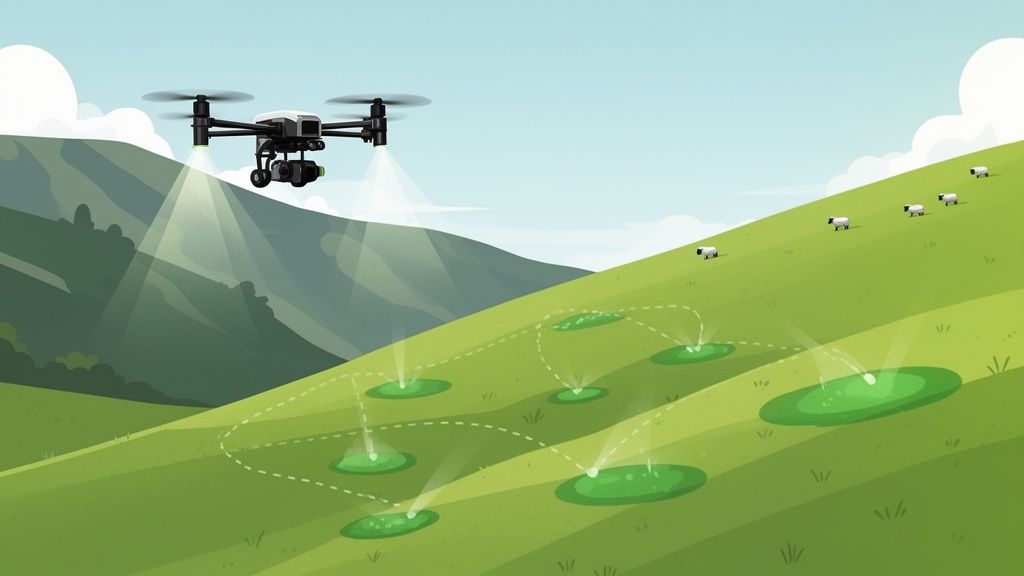
Whether you farm in the steep country of the Waikato or tend to orchards in Northland, the challenges are familiar. You deal with tough terrain, unpredictable weather, and the constant pressure to maximise the value from every dollar you spend. For years, tractors and helicopters have been the standard tools for the job, but they have their limits. They struggle on hills, compact the soil, and can sometimes lead to the wasteful application of expensive products. This is precisely where professional drone services step in to make a real, practical difference on New Zealand farms.
Instead of wrestling with heavy ground equipment or arranging expensive aerial operations, farmers now have a smarter way to work. Advanced agricultural drones can deliver treatments with pinpoint accuracy, targeting only the spots that truly need it. This technology provides a straightforward solution to many of the everyday headaches of farming, boosting productivity and sustainability at the same time. Using drones allows farmers to manage their land and inputs with a level of precision that leads to better results for their crops, their bottom line, and the environment.
The Core Benefits of Drone Application
At its heart, using drones in agriculture is all about working smarter, not harder. This technology puts more control back into your hands, allowing you to manage your land with a new level of precision. The advantages are clear right from the start, offering practical benefits that directly address the challenges of modern farming.
- Access Inaccessible Areas: Drones easily handle steep hillsides, deep gullies, and wet paddocks that are either a no-go zone or simply too dangerous for a tractor. This opens up your entire property to effective management.
- Get the Job Done Faster: A skilled drone crew can often cover ground much quicker than traditional methods, especially in tricky terrain. This speed means you can act fast when the weather window is just right, ensuring timely application.
- Spray with Surgical Precision: By following pre-mapped flight paths, drones ensure agrichemicals and fertilisers are applied exactly where they are needed. This precision cuts down on waste, reduces your input costs, and minimises environmental impact.
Drone technology allows us to apply treatments with a level of care and precision that was simply not possible before. It is about getting the right product, in the right place, at the right time—without leaving a single tyre mark on the paddock.
This shift represents a significant step forward for farming in New Zealand. By neatly sidestepping the limitations of older methods, agricultural drones unlock the potential of land that was once too difficult or costly to manage effectively. It is more than just spraying; it is a strategic tool for securing your farm's health and profitability for the future. To better understand these advantages, let's put drone spraying side-by-side with conventional methods.
Drone Spraying vs Conventional Methods at a Glance
This table gives a quick rundown of how a modern drone spraying service compares to the traditional approaches you might be more familiar with.
| Feature | Drone Spraying Service | Conventional Spraying (Tractor/Helicopter) |
|---|---|---|
| Terrain Access | Excellent; easily handles steep, wet, or complex areas. | Limited; struggles with steep slopes, wet ground, and obstacles. |
| Soil Compaction | None. The drone flies above the ground. | High risk, especially with heavy tractors in wet conditions. |
| Precision | Very high; GPS mapping allows for targeted spot spraying. | Lower; often results in blanket coverage with overspray. |
| Chemical Use | Efficient; minimises waste by applying only where needed. | Less efficient; can lead to higher chemical usage. |
| Operational Speed | Fast, particularly in difficult or fragmented areas. | Varies; can be slow in complex terrain or with ground rigs. |
| Safety | High; operator remains at a safe distance from hazards. | Higher risk; operators are exposed to terrain and chemicals. |
As you can see, drones offer a clear advantage in scenarios where precision, safety, and access are critical. It is a modern approach built for the unique challenges of New Zealand's landscape.
Why Drones Are a Smarter Choice for Your Farm or Orchard
Picking the right tools for your farm or orchard always comes down to what works best in practice. For many Kiwi landowners, the trusty tractor and sprayer have been the go-to for years, but we all know their limitations. When you deal with steep hills, boggy paddocks, or thick orchard canopies, drones for agriculture spraying offer a genuinely smarter way forward, turning those frustrating problems into simple, manageable jobs.
The biggest benefit is getting the most out of every single hectare you own. Every property has those spots—the steep banks thick with gorse, the gullies where weeds get a free run, or the corners of a paddock that stay waterlogged for weeks. These areas are often too dangerous or just plain impossible to get to with a tractor or a spray crew. A drone works from above, hitting these tricky areas with the same precision as the flat, easy paddocks. This capability means you can finally manage your entire property properly, boosting productivity from boundary to boundary and reclaiming underutilised land.
This approach also means you can act fast. Instead of waiting for the ground to dry out after rain, a drone can be in the air as soon as there is a break in the weather. That speed is crucial for getting on top of pests or diseases before they become a serious issue, giving you more control over your operation.
Unlocking Precision and Boosting Efficiency
Beyond just getting into tight spots, the real game-changer with agricultural drones is their precision. Using GPS mapping and automated flight plans, a professional drone service applies chemicals only where they are needed. It is the difference between slapping paint on with a roller versus using a fine-tipped brush for detailed work. This targeted approach gives you several key advantages that directly benefit your farm.
- Less Chemical Waste: By spraying only the weed patches or the specific rows that need it, you significantly reduce your agrichemical use. That is not just good for the environment; it is a direct saving on your input costs.
- Protecting Your Surroundings: Pinpoint accuracy means far less risk of spray drift. Your neighbouring paddocks, sensitive crops, and nearby waterways are kept safe from unintended overspray.
- Healthier Plants: Applying the right amount of product in the right place results in healthier crops and pasture. You avoid over-application, which can stress plants, and you achieve better control of whatever you are targeting.
A drone’s ability to fly a pre-planned route means every square metre receives perfectly consistent and even coverage. That level of accuracy is almost impossible to match with ground-based methods, especially over rough terrain, and it leads to better results and higher yields.
This efficiency extends beyond the spraying itself. With no heavy machinery involved, you eliminate the fuel, the wear and tear, and the long hours that come with traditional methods. One skilled operator can manage the whole process, freeing you and your team up for other important jobs around the farm.
Championing a Healthier Farm Environment
Switching to drone spraying is also a big step forward for the long-term health of your land. One of the biggest downsides of heavy equipment is soil compaction. Year after year, the weight of tractors can damage your soil structure, reducing its ability to absorb water and air, which in turn harms root growth and makes your pasture less resilient. Drones never touch the ground, so that problem is completely eliminated.
This gentle approach preserves your soil structure, leading to better drainage, healthier root systems, and more vigorous pasture for years to come. Plus, by swapping a diesel-powered tractor for a battery-powered drone, you shrink your farm's carbon footprint. It is a practical way to farm more sustainably without sacrificing an ounce of productivity. Ultimately, choosing drones is a strategic move for the future of your operation, offering a safer, more efficient, and environmentally sound way to manage your land.
The Professional Drone Spraying Process from Start to Finish
To fully appreciate how drones for agriculture spraying can work for you, it helps to understand the professional process behind every job. It is a long way from simply flying a drone over a paddock. You should think of it as a finely tuned service built on precision and care, from the first phone call right through to the final report. This workflow is designed to deliver effective, reliable results with total transparency, ensuring every application hits its mark. It is all about optimising access, applying treatments with precision, and ultimately improving the health of your land.
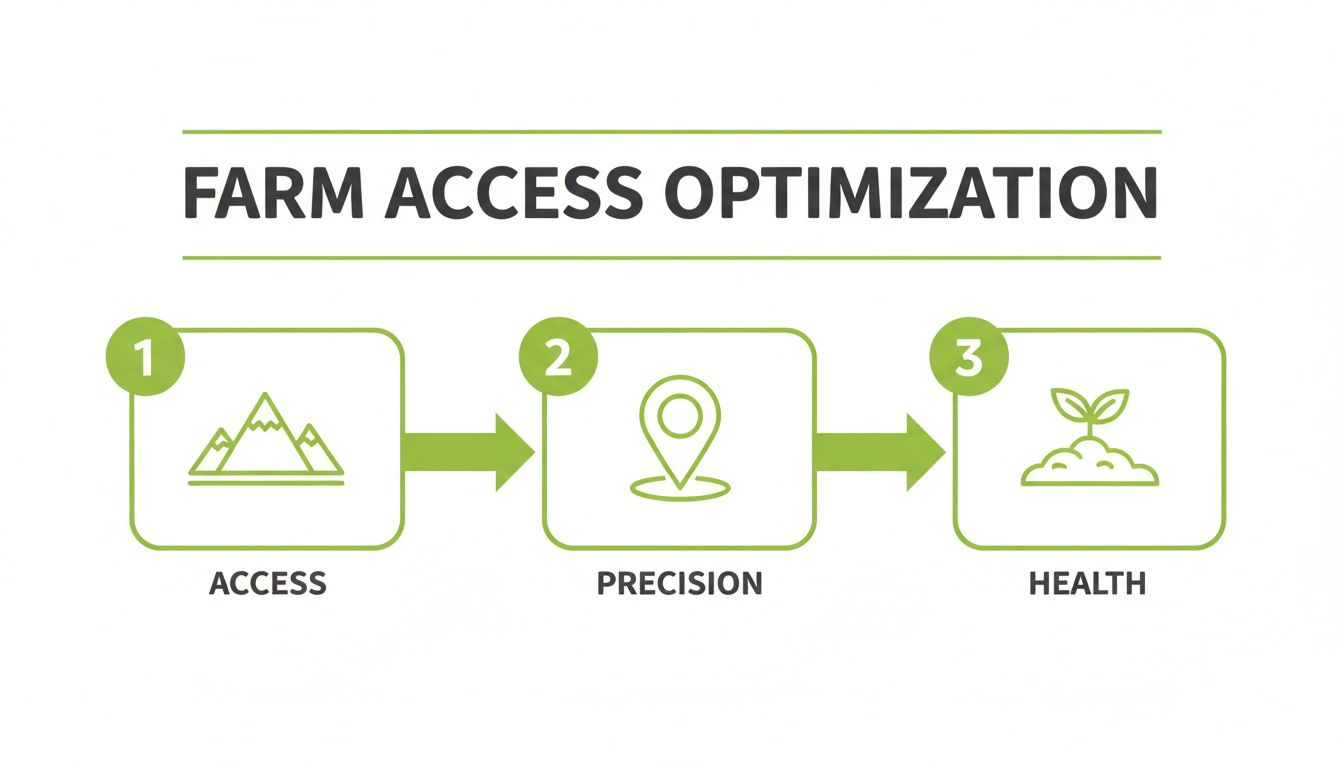
This visual breaks down the key stages: first, getting to those hard-to-reach spots; then, applying treatment with pinpoint accuracy; and finally, seeing better land health as a result.
Initial Consultation and Site Assessment
Every professional drone spraying job kicks off with a detailed discussion. A specialist will talk through exactly what you need, whether that is knocking back gorse on a steep hillside, applying fertiliser to a new crop, or managing pests in your orchard. From there, the process moves to a thorough site assessment. The team gets boots on the ground to evaluate the terrain, identify any potential hazards, and gain a proper understanding of your property’s unique layout. This essential groundwork allows them to craft a plan that fits your goals perfectly and sets the stage for a smooth, successful operation.
Advanced Mission Planning
With the site assessment complete, it is time for mission planning. Using specialised software, the operator creates a precise, automated flight path for the drone. This digital map considers everything—elevation changes, property boundaries, and any exclusion zones like waterways or sensitive neighbouring areas. This careful planning is what allows for such incredible accuracy.
You can think of the flight plan as the brains of the operation. It tells the drone exactly what speed, altitude, and spray rate to use, guaranteeing complete and uniform coverage. It takes all the guesswork out of the equation.
This meticulous approach ensures every drop of product goes exactly where it is intended, making the application more effective while cutting down on waste and environmental impact.
On-Site Execution and Quality Control
On the day of the job, the certified pilot runs through a full series of pre-flight checks. They will verify battery levels, calibrate the spray system, and ensure every safety feature is operating correctly. The agrichemicals or fertilisers are then mixed and loaded according to industry best practices. Once everything is in place, the pilot launches the pre-planned mission. They keep a close eye on real-time data feeds throughout the flight, tracking progress and ensuring the application runs exactly as it should. For larger jobs, the ground crew manages quick battery swaps and refills to keep the operation running seamlessly without long delays.
This efficiency has turned drone spraying into a serious tool for large-scale farming in New Zealand. Professional services can now cover significant areas, with some providers treating 10 to 20 hectares per day for targeted work and scaling up to 30-40 hectares for broader applications like pasture spraying.
Post-Mission Reporting and Analysis
The job is not over when the drone lands. A professional service will always follow up with a detailed report. This usually includes maps showing the exact areas treated, data on how much product was applied, and confirmation that the job was completed as planned. This documentation provides you with a clear record of the work done, which is invaluable for compliance and for planning your next steps. You can learn more about our specific drone crop spraying services and see how we can help boost your farm's productivity.
Solving New Zealand's Toughest Agricultural Challenges
It is one thing to talk about the benefits of drone spraying, but it is another to see how it tackles the real, everyday headaches facing Kiwi farmers and landowners. This is not just fancy tech; it is a practical tool that steps in where old-school methods struggle, turning tough, expensive jobs into something manageable and cost-effective. Whether you deal with rugged hill country or carefully tended orchards, drones offer a level of precision and access that is perfectly suited to our unique landscape.
Conquering Gorse and Invasive Weeds on Hill Country
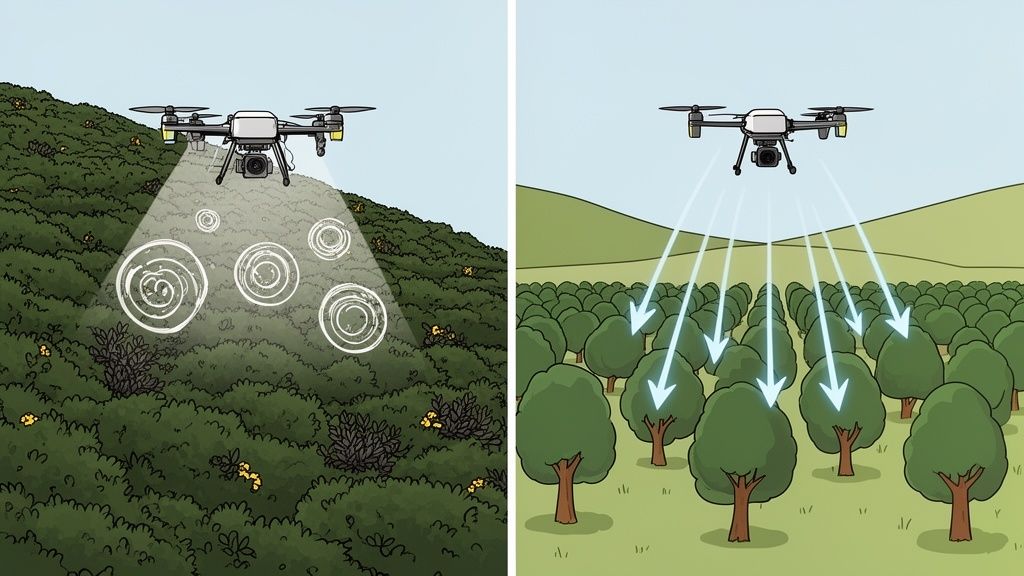
Getting rid of gorse, blackberry, and broom on steep terrain is one of the most difficult and dangerous jobs on a farm. Ground crews are at serious risk trying to navigate that sort of country on foot, and helicopters, while an option for widespread coverage, are expensive and not very accurate for smaller, scattered patches. This is where drones really excel. They can safely target dense patches of weeds on hillsides you simply cannot get to otherwise. By programming a precise flight path, a professional drone service ensures the spray goes directly onto the problem plants, which means less runoff and better protection for surrounding native bush or pasture. This targeted approach is not only safer but also far more cost-effective because you use less product to get a better result. To see how this works in the real world, check out our dedicated drone gorse spraying services.
Deep Canopy Penetration for Orchards and Horticulture
For high-value crops like kiwifruit, apples, or avocados, effective pest and disease control is critical. Getting full spray coverage inside a dense canopy is a massive challenge for ground sprayers, and it is easy to miss spots where problems can take hold. Agricultural drones use their powerful rotors to solve this. The rotors create a strong downward blast of air that actively forces the fine spray droplets deep into the plant canopy, ensuring comprehensive coverage.
This ‘prop wash’ effect makes sure the undersides of leaves and the inner parts of the plant get a thorough, even coating. The result is more effective pest control and better disease prevention, which leads directly to healthier crops and bigger yields.
Because the drone flies consistently above the canopy, there is no risk of damaging the plants or compacting the soil between rows, keeping the whole orchard healthier in the long run. This precision application helps protect your valuable crops and maximise your return.
Targeted Solutions for Pasture and Crop Management
When it comes to pasture and broadacre cropping, efficiency is the name of the game. Blanket-spraying an entire paddock just to deal with a few patches of thistle or dock is wasteful and costs a fortune. Drones offer a much smarter way forward with spot spraying. After identifying and mapping out weed-infested areas, a drone can be sent to treat only those specific spots. This massively cuts down on the amount of herbicide used—a huge cost saving and a big tick for the environment. The same logic applies to feeding your crops. Drones can deliver targeted doses of liquid fertiliser exactly where a crop needs a boost, making sure every drop is used efficiently. This precision helps you get more uniform crop growth and optimises the productivity of your land.
Safe and Efficient Property Maintenance
The usefulness of drones does not stop at the paddock fence. Many farms and commercial properties have large sheds or workshops with roofs that are a pain—and a danger—to maintain. Over time, moss, mould, and lichen can build up, degrading the surface and leading to expensive repairs. Climbing onto a roof to spray it comes with an obvious risk of working at height. A drone takes that danger completely out of the equation. It can be programmed to fly a systematic pattern over the roof, applying cleaning or protective treatments safely and efficiently. It is not just safer for your team; it is also much quicker than doing it by hand. It is a perfect example of how drone technology solves a common problem with more care, precision, and safety.
Understanding the Costs and Return on Your Investment
When you look at any new tool for your farm, it always comes down to the numbers. Let's get straight to what every farmer wants to know: what is it going to cost, and is it actually worth it? The price of a professional drone spraying service is not a flat fee. It is carefully calculated based on a few key factors to ensure you get the best value for your specific situation. The main factor is the total area you need treated, measured in hectares. However, it is not just about size. The complexity of your land plays a huge part; a steep, rough hillside with plenty of obstacles takes more planning than a flat, open paddock. The type and amount of product being applied—whether it is a herbicide, liquid fertiliser, or fungicide—also shapes the final cost. Looking only at the price tag, though, misses the bigger picture of what drones for agriculture spraying really bring to the table.
Analysing the Return on Your Investment
The real value of bringing in a drone service shines through when you look at the return on investment (ROI). This is not just about what you spend; it is about what you save and what you gain in the long run. The financial benefits kick in straight away with direct cost reductions that you will see on your bottom line.
- Reduced Chemical and Fertiliser Use: Precision application means the product goes exactly where it needs to, and nowhere else. Slashing that waste translates directly into lower input costs.
- Lower Labour Requirements: A single certified drone operator can complete a job that might otherwise tie up multiple staff and hours of manual work, freeing up your team for other important tasks.
- Zero Fuel Consumption: Swapping a diesel-guzzling tractor or ute for a battery-powered drone completely cuts fuel costs for the application. That adds up to big savings over time.
These immediate savings are just the beginning. The true ROI builds up through the added value and long-term gains that boost the overall health and productivity of your farm.
The Added Value of a Smarter Approach
Beyond the instant cost cuts, drone spraying delivers powerful secondary benefits that put you in a stronger financial position. One of the biggest advantages is the ability to act fast. Drones can get to work in tight windows of opportunity, like right after rain when the ground is far too wet for a tractor. That kind of timing can be the difference between controlling a pest outbreak and losing a significant portion of your yield. This improved application effectiveness also leads to healthier crops and pasture, which naturally means higher yields.
A strategic investment in drone spraying is an investment in your farm's productivity and long-term sustainability. By protecting your soil and enabling more effective treatments, you are building a more resilient and profitable operation for the future.
What is more, by completely eliminating soil compaction from heavy machinery, you protect the long-term health of your most valuable asset—your land. Healthier soil structure means better water absorption, stronger root systems, and more resilient pasture, all of which have lasting financial benefits. For a real-world example of these efficiency gains, Felton Road Wines in Central Otago found their electric drone gets spraying jobs done 50-60% faster than their old tractor methods, while also cutting labour time by up to 60%. Those numbers show that drone spraying is not just an expense; it is a powerful investment in efficiency. You can explore a full breakdown of different tools in our guide to agricultural spraying equipment in NZ.
How to Choose the Right Drone Spraying Partner
Deciding to use drone spraying is a big step, but picking the right partner to do the job is just as important. The success of the application—the quality, care, and precision—all comes down to the team you hire. Making a good choice here is the key to getting the results you are after and making sure your investment pays off. The first thing you need to check is non-negotiable: ensure the operator holds a current Civil Aviation Authority (CAA) Part 102 certification. This is the legal requirement for any commercial drone operation in New Zealand. It is your guarantee that the provider follows strict safety rules, operates legally, and maintains a high professional standard on every job.
Assess Their Equipment and Expertise
Once you have confirmed their certification, take a look at the equipment they use. Professional drones for agriculture spraying, like the DJI AGRAS series, are built specifically for tough farm work and accurate application. Ask potential partners about their drone fleet, what it can do, and how they maintain it. Modern, well-looked-after equipment is a great sign of a quality service that is serious about precision. However, having the best gear is only half the battle. Real expertise comes from a solid understanding of agronomy and local conditions.
The best drone spraying partner understands the 'why' behind the application, not just the 'how'. They should be able to discuss your specific crop or weed problems and explain their strategy for controlling them.
This practical, on-the-ground knowledge is what separates a drone pilot from a genuine agricultural specialist. A great partner becomes an extension of your own farm team, offering advice that adds real value to your operation.
Look for a Consultative Approach
When you chat with a potential provider, notice the kind of questions they ask you. Are they digging into your specific goals, crop types, or the particular weeds giving you grief? A quality operator will want to understand your unique situation so they can tailor a solution that actually works for you. Here are a few things you could ask them about their process:
- Mission Planning: How do they map your property and plan the flight to get full, accurate coverage without missing spots or overlapping?
- Operational Experience: Have they dealt with your specific crop or the type of weeds you are fighting before? What did they learn from that experience?
- Reporting: What sort of report will you receive after the job is done? It should confirm exactly what was applied and where.
This kind of consultative approach shows they are committed to your success. As New Zealand's agricultural drone sector keeps growing, choosing a partner who understands local farming and values precision is essential. The global agriculture drones market is expanding fast, as more farmers look for smarter ways to work. You can find out more about this market growth on cognitivemarketresearch.com. At the end of the day, you are not just buying a service; you are looking for a partner who is invested in the long-term health of your farm.
Frequently Asked Questions About Drone Spraying
Here are a few of the most common questions we get from farmers and landowners about agricultural drone spraying. We've answered them with straightforward, practical information to show you how this technology really works on the ground.
Is Drone Spraying Safe for Livestock and the Environment?
This is the first question on every responsible landowner’s mind, and rightly so. The short answer is yes. Professional drone spraying is built around precision and control. Unlike broad-scale methods, our drones use highly accurate GPS mapping to follow a pre-planned route, applying product only where it's needed. This accuracy is the cornerstone of its safety. The drone’s rotors also create a powerful downward airflow, pushing the droplets directly onto the target plants and significantly reducing the risk of spray drift. We also establish clear buffer zones around waterways, sensitive areas, and neighbouring properties. It is all about keeping the treatment exactly where it is meant to be, protecting your stock and the local environment.
With a professional service, every step is managed with quality and safety in mind. This careful process protects your livestock, your land, and your peace of mind.
What Weather Conditions Can You Operate In?
Like any aircraft, drones have their limits. We constantly monitor the weather and will not spray in high winds that could cause drift or during heavy rain that would just wash the product away. A professional operator will always put safety and effectiveness first. However, this is where drones have a massive advantage over traditional machinery. After a good downpour, when the ground is far too wet and soft for a tractor, a drone can get straight to work. This ability means you can take advantage of those narrow windows of opportunity to get on top of a weed or pest problem without churning up your paddocks or getting bogged.
How Do I Know If My Property Is Suitable?
While a proper site assessment is the only way to know for sure, the great news is that drones are incredibly versatile. In fact, they are often the perfect tool for properties that are completely unsuitable for other methods. Drones really excel on tough terrain, including:
- Steep Hillsides: We can safely treat slopes that are simply too dangerous for a tractor or a ground crew.
- Complex or Fragmented Areas: Drones easily navigate around obstacles, gullies, and those small, awkward corners of a paddock.
- Wet or Inaccessible Ground: We can fly over boggy areas or dense scrub that would stop a tractor in its tracks and cause serious damage.
If you have parts of your property that are a nightmare to manage, there is a very good chance it is a prime candidate for drone spraying. This technology is designed to solve exactly these kinds of access problems with precision and care.
Ready to see how AgriUAS Limited can solve your toughest spraying challenges with precision and care? Take the next step towards a more efficient and productive farm.