
Imagine treating just the problem spots in your steepest gully or wettest paddock—all without leaving a single tyre mark. This is the new reality that agricultural drone spraying brings to New Zealand farms. It represents a smarter, more nimble approach to land management, moving beyond the limitations of older, more cumbersome methods. This guide explores how modern drones deliver targeted applications of fertilisers, pesticides, and weed killers with incredible accuracy and care, helping you get more done with less, reduce waste, and improve the health of your land.
The Future of Farming is Here
For generations, Kiwi farmers have relied on tractors and helicopters, and while they have served us well, they come with drawbacks. Heavy machinery compacts precious soil, damaging pasture and hurting long-term productivity. Helicopters are often expensive and impractical for smaller, specific jobs. Both methods can struggle to achieve even coverage on the steep, rolling country we see all over the Waikato and greater North Island. This is where agricultural drone spraying offers a clear advantage. Drones are agile, flying low over the target area where the downward force from their rotors pushes the spray mix deep into the plant canopy, ensuring it sticks. This action drastically reduces drift, so the product lands exactly where intended—keeping nearby paddocks and waterways safe.
A New Standard in Precision and Care
The benefits of drone technology extend far beyond just applying a product. Drones enable data-driven farming, allowing us to map out paddocks, pinpoint problem areas, and send the drone on a pre-planned mission with centimetre-level accuracy. This precision changes the game entirely by allowing targeted action, such as treating only patches of gorse or thistle instead of blanket spraying an entire paddock, which leads to huge savings on chemical costs. Drones also provide unmatched access to difficult terrain; those wet, boggy gullies or steep hillsides that were once no-go zones for a tractor are now simple and safe to treat. Furthermore, the operational agility of drones means we can get in and get the job done quickly, taking full advantage of short weather windows to spray when it counts the most.
Agricultural drone technology is about working smarter, not harder. It gives farm managers the power to apply the right product, in the right place, at the right time—all while protecting the health of their land and crops.
This method represents a massive step forward, blending precision with practical, on-the-ground efficiency. You can see this technology in action across a variety of New Zealand landscapes in our project gallery. Whether you’re running a large orchard or a lifestyle block, drone spraying offers a flexible and effective solution tailored to your needs.
How Precision Drone Technology Actually Works
To fully appreciate why drone spraying is so effective, it is important to understand how the technology works on the ground and in the air. This is not simply a drone with a tank strapped to it; it is a sophisticated combination of ultra-precise navigation and advanced spray systems, all designed to deliver the best results for your land with exceptional care. It all starts with the drone itself. We operate top-of-the-line models like the DJI AGRAS T50, which comes equipped with RTK (Real-Time Kinematic) positioning. Unlike standard GPS, RTK provides centimetre-level accuracy, meaning the drone knows its exact location down to the width of your thumb. This incredible precision is the foundation of our work, allowing us to plan and fly spray missions with total control and ensuring every drop of product is used efficiently and responsibly.
Intelligent Flight Planning for Optimal Results
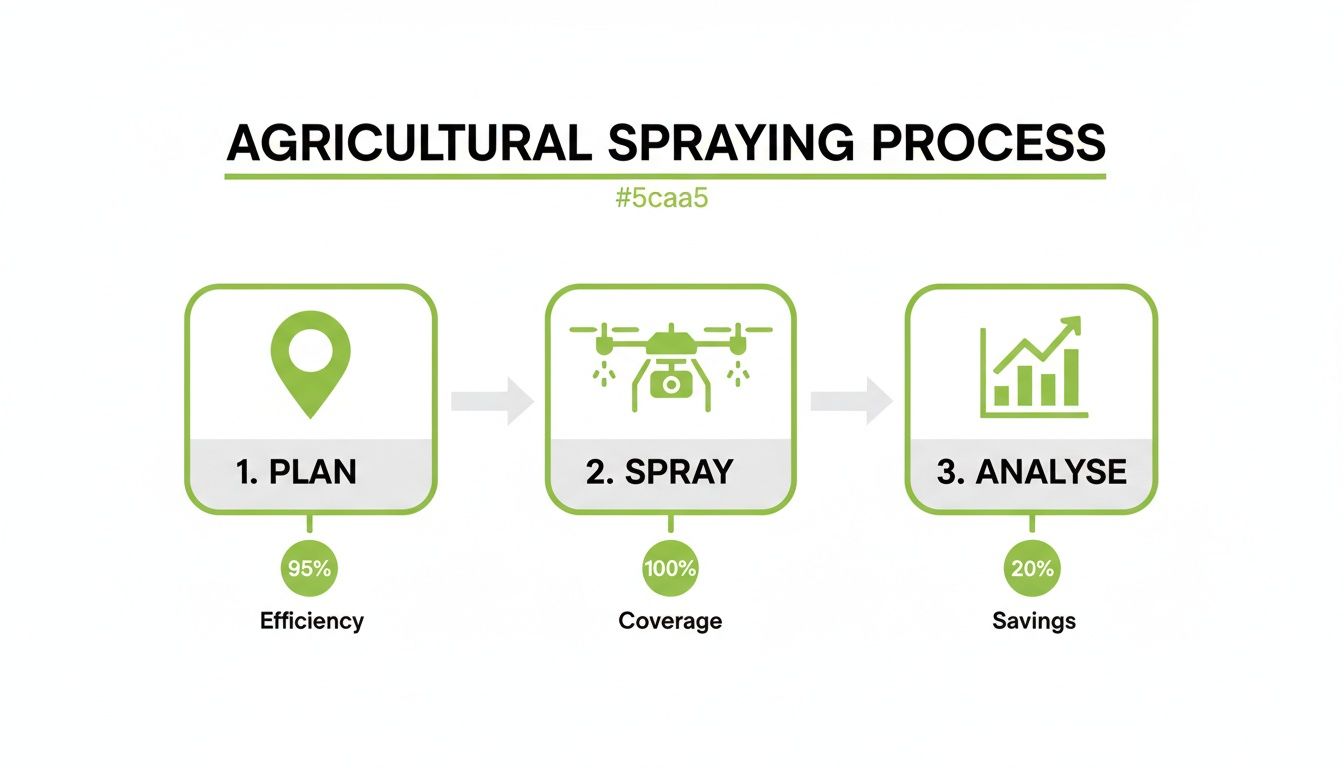
Long before a drone lifts off, our team creates a detailed flight plan using specialised software. We map your property to build an automated mission that follows the exact contours of your land, whether that’s a steep Waikato hillside or a flat market garden near Auckland. This digital map becomes the drone’s playbook, telling it precisely where to fly, at what height, and at what speed. The system automatically adjusts for terrain changes, avoids obstacles, and adheres to the application rates we have set. This planning stage is non-negotiable for achieving a consistent, targeted application every time and is central to our commitment to quality.
Advanced Application for Superior Coverage
While pinpoint navigation gets the drone to the right spot, the real work happens when the spray is released. The technology on board is designed to place the product exactly where it needs to go with minimal waste. Our drones use advanced centrifugal atomisers that spin liquid into a fine, consistent mist, which is crucial for achieving even coverage and ensuring the product is absorbed effectively. The drone’s powerful propellers create a focused column of air known as ‘rotor downwash’ that actively drives the mist deep into the crop canopy, coating both the tops and undersides of the leaves—a result difficult to achieve with other methods. This combination of fine mist and downward pressure massively reduces spray drift, pinning the product right where it is meant to go and protecting nearby paddocks, waterways, and other sensitive areas.
At its heart, this technology is all about control. By managing the droplet size, flight path, and air pressure, we ensure the product does its job properly, giving you far better coverage than traditional ground or aerial spraying can.
This focus on precision means less chemical is wasted, your crops receive better protection, and the environmental impact is kept to a minimum. It’s a smarter way of farming that brings together powerful hardware and intelligent software to solve real-world problems.
What This Means for Your Farm
So, what does all this technology mean for your day-to-day operations? For farmers here in the Waikato and greater Auckland region, drone spraying is not just a novelty—it is a practical solution to some of our oldest challenges. It is about achieving better results where it counts, with less waste and less hassle. The biggest game-changer is unmatched accessibility, as drones can get into all those 'impossible' spots. Think of those steep, gorse-choked hillsides, soggy gullies, or boggy corners of a paddock that have always been a write-off. Places where a tractor would get stuck and a helicopter is overkill. Drone spraying turns these problem areas into productive, well-managed parts of your farm, allowing every square metre of your land to be cared for with precision.
Speed, Agility, and Perfect Timing
Another significant advantage is the sheer speed and flexibility drones offer. Farming is all about timing, and we all know how frustrating it is when the weather won't cooperate. Because our drone systems deploy so quickly, we can act on narrow windows of opportunity—like a calm morning before the wind picks up or a brief dry spell between downpours. This agility means your crops get what they need, exactly when they need it. Whether that’s a fungicide to stop blight in its tracks or a quick foliar feed during a key growth spurt, we can get it done swiftly. It is a world away from the slow process of scheduling heavy machinery, giving you more control over your farm’s productivity.
Protecting Your Two Greatest Assets: Soil and Crops
Perhaps the most important long-term benefit of agricultural drone spraying is what it doesn't do: it doesn't harm your soil. Heavy tractors and ground sprayers compact the earth, squeezing the life out of it by reducing aeration and stopping water from reaching the roots. By working from the air, drones leave no tracks and cause zero soil disturbance, ensuring your soil stays healthy, your pasture remains lush, and your crops grow stronger. This means no soil compaction, zero crop damage from flattened plants or crushed rows, and no torn-up pasture.
By taking heavy machinery out of the picture, you're investing in the long-term health of your land. This isn't just about good land management; it translates directly to better yields and a more resilient farm for years to come.
New Zealand's mix of dairy, beef, and horticulture comes with unique terrain that drones are perfectly built to handle. Top-tier models like the XAG P100 Pro or DJI AGRAS T50 can cover over 10 hectares per hour. Operators are finding these drones invaluable for getting into steep, wet paddocks that are off-limits for tractors, preventing the soil compaction that can slash pasture productivity by up to 15% annually here in the Waikato and Auckland. This allows us to tackle anything from precise fertiliser jobs to crop protection, where old-school methods often cause 20-30% more soil damage. You can learn more about how Airborne Solutions NZ handles these challenges on their site.
Saving Money and Caring for the Environment
Ultimately, it all comes down to efficiency. Because drone spraying is so precise, we use less product and less water to get the job done right. The targeted application and minimal spray drift mean you are not wasting expensive chemicals, and those savings go straight to your bottom line. Better yet, using less chemical and applying it exactly where it needs to go is a huge win for the environment. It dramatically reduces the risk of runoff into our waterways and protects surrounding biodiversity, proving that productive farming and good environmental stewardship can, and should, go hand-in-hand. By bringing this technology onto your farm, you’re not just improving your finances—you’re protecting the health of your land.
Common Drone Spraying Applications in NZ
This is where the real value of agricultural drone spraying becomes clear. Across New Zealand, from high-value orchards to rugged hill country, drone spraying is delivering tangible results. It is a versatile tool that allows us to tackle a huge range of jobs with a level of precision that was simply out of reach before. Here in the North Island, this technology is being put to work to solve everyday challenges for Kiwi farmers and growers.
Precision Orchard and Viticulture Spraying
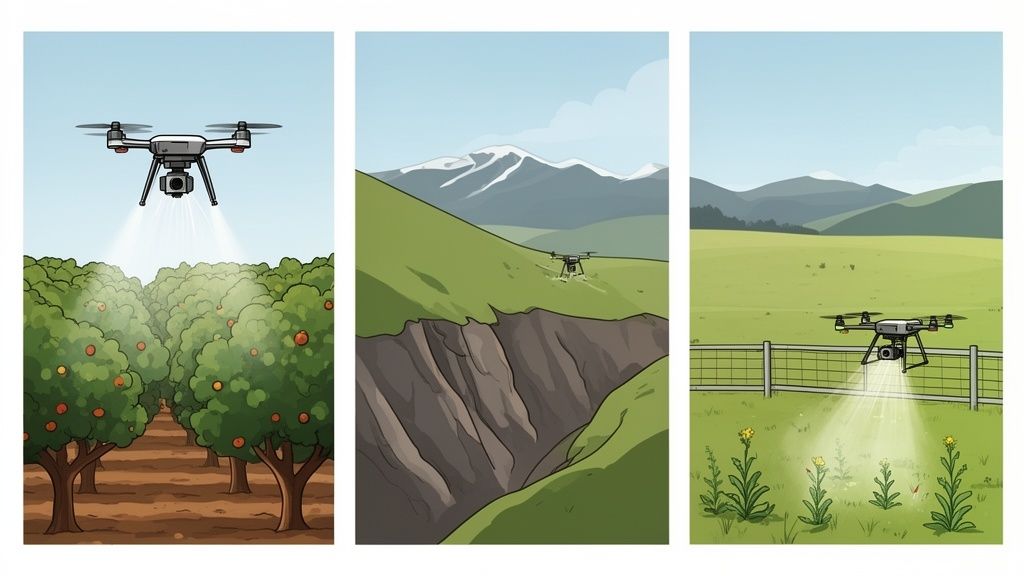
For anyone growing fruit or grapes, achieving complete and even spray coverage is essential. Drones are perfectly suited for these complex environments, as they can navigate tight rows and apply treatments directly into the plant canopy to ensure nothing is missed. This targeted approach is a game-changer on New Zealand’s often steep horticultural blocks, where using traditional machinery can be risky. By placing the product exactly where it is needed and nowhere else, drones make it possible to reduce chemical use by up to 30% compared to standard boom sprayers. This means less waste, no runoff, and healthier soil and waterways. To learn more, have a look at our guide on targeted orchard spraying solutions.
Pasture, Cropping and Fertiliser Management
Keeping pasture healthy and protecting crops like maize is the foundation of profitable farming. Drone spraying offers a fast, effective way to apply liquid fertilisers and pest control with surgical accuracy. Flying directly over the crop eliminates soil compaction and plant damage caused by heavy tractors. The drone's downward rotor wash is a key advantage here, as it actively pushes the spray down into the crop for incredibly thorough coverage. It is also ideal for applying fertiliser at the precise time and location it is needed to stimulate a timely growth boost, maximising the effectiveness of your inputs.
Targeted Weed and Gorse Control
Weed control, especially for invasive species, is one of the most powerful applications for drone spraying. Gorse, blackberry, thistle, and other noxious weeds often thrive in steep, inaccessible spots where they are a nightmare to control safely. Drones provide the perfect answer. With spot-spraying accuracy, we can pick out and treat individual patches of weeds without blanketing the entire paddock, which saves a huge amount on chemical costs. Drones easily and safely reach steep gullies, riverbanks, and dense scrub that are no-go zones for ground gear. By only targeting invasive plants, we protect the healthy pasture and native vegetation around them, delivering a smarter approach that is not only more cost-effective but also far better for the long-term health of your land.
Drone technology allows us to manage invasive weeds with a level of precision that protects your most valuable asset—your land. It’s about removing what you don’t want while carefully preserving what you do.
Property Care and Roof Treatments
The usefulness of drone spraying does not stop at the farm gate. For large rural sheds, commercial buildings, or lifestyle blocks, drones provide a safe and efficient way to apply roof treatments. Getting rid of moss, mould, and lichen is crucial for protecting your roof, but climbing up on ladders always carries a risk. A drone can apply a perfectly even coat of treatment solution across the entire roof in a short amount of time, with no one having to leave the ground. This method ensures full coverage, extends the life of your roof, and keeps your property looking sharp with minimal fuss.
Understanding Drone Spraying Rules and Safety
When you bring in a contractor for any aerial work, trust and safety are paramount. In New Zealand, agricultural drone spraying is a tightly regulated industry designed to protect you, your land, and the environment. Every flight is taken seriously, guided by strict rules that prioritise quality and care. The most important of these is the Civil Aviation Authority (CAA) Part 102 certification. This is not just a recommendation; it is a non-negotiable requirement for any commercial drone operation in NZ, especially for complex tasks like agricultural spraying. It is much more than a simple licence—it is a complete operational framework that defines how a professional, safe, and effective service is run.
What Part 102 Certification Means for You
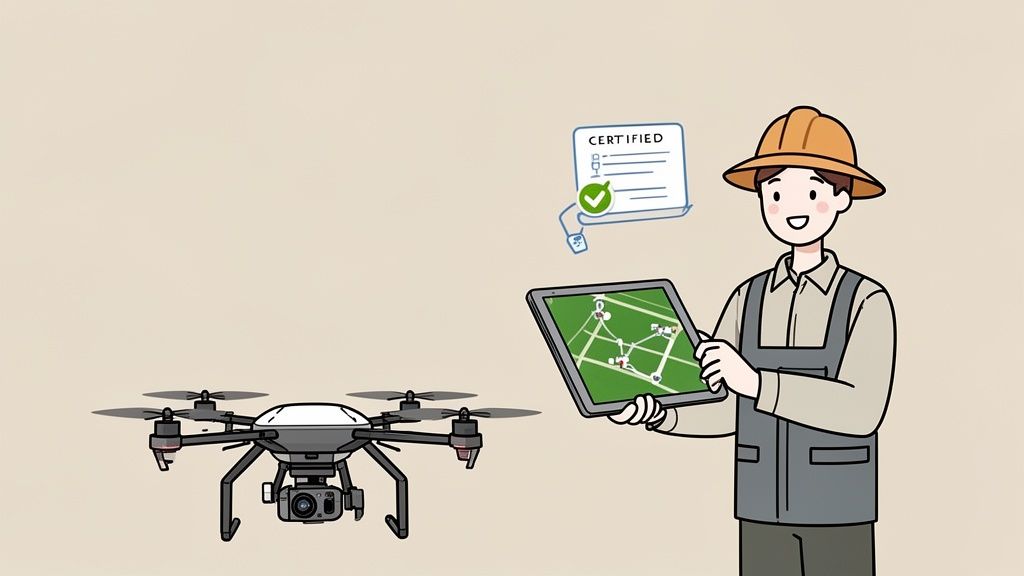
Choosing a drone spraying provider with Part 102 certification means you are working with a business that the CAA has properly vetted. It is your assurance that the operator is not just flying a drone but running a professional operation built on a foundation of safety. To obtain and maintain this certification, a provider must demonstrate rigorous operator training, where pilots prove they can handle advanced drones like the DJI AGRAS T50 competently and safely. They must also have detailed safety procedures covering every aspect of the job, from pre-flight checks to emergency protocols, and maintain meticulous maintenance logs for all equipment. Hiring a certified operator gives you confidence that your project will be completed correctly, meeting the highest industry standards every time.
A Professional Approach to Every Job
A certified operation is much more than just putting a drone in the air; it involves a systematic, planned approach where nothing is left to chance. Every detail is managed carefully from the moment we arrive to the moment we leave. Before a drone even starts its rotors, a certified team builds a detailed flight and safety plan. This is not just paperwork; it is our blueprint for the job. It identifies any potential hazards on your property, defines clear operational boundaries, and ensures public safety remains the top priority. This plan also covers the careful management of the products being sprayed, from handling and mixing to application and cleanup.
A Part 102 certification is your guarantee that the team working on your land operates with the utmost care. It means they have the expertise, the processes, and the proven commitment to deliver a safe, effective, and professional agricultural drone spraying service.
When you work with a certified professional, you are not just hiring someone to fly a drone. You are bringing in a specialist team focused on achieving the best results for your property while adhering to the highest standards of safety and quality. This level of planning and care is what separates a professional from an amateur and gives you complete peace of mind.
Choosing the Right Drone Spraying Partner
Getting the best results from agricultural drone spraying truly comes down to who you choose to do the job. As more operators appear across Auckland and the Waikato, it is crucial to find a partner who delivers on quality, care, and precision. The service you receive directly impacts the outcome on your farm, orchard, or property. The very first question you should ask concerns their certification. Any professional and legal operator in New Zealand must hold a current Civil Aviation Authority (CAA) Part 102 certificate. This is not just red tape; it is your guarantee that they follow strict safety rules, maintain their equipment properly, and have undergone the necessary training. Do not hesitate to ask to see it—this single document separates the professionals from the amateurs and ensures the operation on your land is safe and responsible.
Look Beyond the Drone for True Expertise
Once you have confirmed their certification, it is time to dig a bit deeper. A top-notch partner will not just show up with a drone and start flying; they should take the time to understand your property and its unique challenges. A truly professional provider will demonstrate their commitment to quality through relevant experience, modern equipment, and a custom plan. Ask if they have done similar work before, whether it’s tackling gorse on steep country or applying fungicide to a tricky orchard canopy. Enquire about the drones they fly, as newer models use advanced positioning for centimetre-level accuracy. Most importantly, a great operator will work with you to map out a strategy, ensuring they understand your goals and can create a data-driven plan to achieve the best possible result.
Choosing a provider is about more than just hiring a drone; it’s about partnering with an expert who combines technical skill with a genuine understanding of local farming needs. This ensures every flight is planned with care and executed with precision.
Ultimately, you are looking for a local expert who is as invested in your success as you are. They should be transparent about their methods, easy to communicate with, and focused on delivering real, measurable results. Finding a partner who embodies these values will help you get the most out of this powerful technology. To see how a professional team approaches different challenges, take a look at the range of specialised drone spraying services we offer.
Frequently Asked Questions
New technology always brings up a few questions. We've put together answers to some of the most common queries we get from farmers and landowners across New Zealand to give you a clearer picture of how drone spraying can work for you.
Is Drone Spraying More Expensive Than Traditional Methods?
It's a common question, and the short answer is no—in fact, it’s often more cost-effective when you look at the whole picture. The hourly rate might seem different at first, but the real value is in the precision. Because drones are so accurate, we often see chemical use cut by up to 30%, which is a significant saving. You also completely eliminate the crop damage and soil compaction that comes with heavy tractor tyres rolling through your paddocks. When you start factoring in the ability to finally treat those hard-to-reach, high-value bits of land, the return on investment really stacks up. For jobs like spot-spraying gorse or blackberry, the chemical savings alone make it a smart choice compared to blanket spraying an entire area. We provide a tailored quote for every job, ensuring you get the best value for your specific property.
How Does Weather Affect Drone Spraying Operations?
Weather is the boss in any aerial application, and we treat it with the respect it deserves. Wind and rain are the two big ones that can mess with the quality and safety of a job, so we work within very strict weather windows to guarantee a precise, drift-free application every time. If the wind is up, our operators will always postpone.
One of the biggest advantages of our drone systems is their agility. We can mobilise quickly to make the most of short, calm weather windows—like early mornings or brief dry spells—getting your job done when conditions are perfect for the best results.
What Information Do I Need for a Quote?
To give you an accurate quote and a solid plan, we just need a few key details about your property. This helps us get a good handle on the job and make sure our approach is spot-on for what you need. If you can provide the following, we can do a thorough preliminary assessment:
- Location: The property address or a digital map file (like a KML) showing the boundaries of the area you want treated.
- Area Size: The total hectares that need spraying.
- Application Type: Let us know what you need sprayed—whether it's fungicide, liquid fertiliser, or a specific herbicide for weeds like gorse.
- Known Hazards: A heads-up on any obstacles like power lines, sensitive neighbouring properties, or waterways is always appreciated.
Ready to see how AgriUAS Limited can bring precision, quality, and care to your property? Contact us today for a no-obligation quote and let’s create a tailored plan to meet your agricultural drone spraying needs. Learn more at https://agriuas.co.nz.