
For generations, Kiwi farmers have relied on tractors and helicopters to manage their land. These methods have served us well, but they come with their own set of challenges. The real advantage of drone spraying lies in its unmatched precision, ability to access tough-to-reach spots, and significant reductions in chemical waste and soil compaction. It is a smarter, safer, and more sustainable way to care for your land.
Why NZ Farmers Are Making the Switch to Drone Spraying
Modern farming in New Zealand is a careful balancing act. Achieving high productivity while being a good steward of the land is essential. For years, ground rigs and helicopters have been the go-to solutions, but they often create persistent problems. Tractors, particularly on wet Waikato soils, can cause serious soil compaction, which damages pasture root structures and compromises long-term productivity. While manned aircraft are fast over large, open areas, they lack the pinpoint accuracy needed for targeted jobs, often leading to chemical drift and wasted resources. These frustrations are precisely why many farmers are now seeking a better way forward.
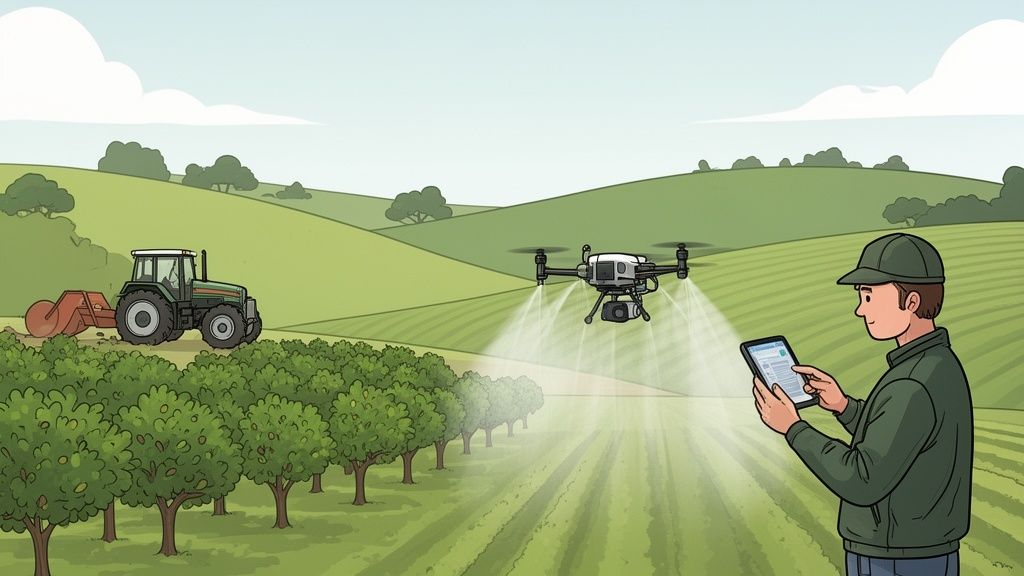
This is where drone technology offers a practical solution. For farmers, orchardists, and land managers across the country, adopting drone spraying is not about following a trend—it is a logical step that delivers real-world benefits. Drones operate with centimetre-level accuracy, applying expensive herbicides, pesticides, and fertilisers exactly where they need to go, and nowhere else. This targeted approach achieves better results while protecting nearby waterways and sensitive areas from chemical runoff, demonstrating a commitment to quality and environmental care.
Comparing Old School vs. New School Spraying
The difference between these methods becomes clear when you compare them side-by-side. Drones provide a level of control and access that traditional equipment simply cannot match, especially across New Zealand’s rugged and varied landscapes.
| Feature | Drone Spraying | Traditional Ground Spraying | Traditional Aerial Spraying |
|---|---|---|---|
| Terrain Access | Excellent; handles steep hillsides, wet ground, and tight corners with ease. | Poor on tricky terrain; gets bogged down on slopes and soft soil. | Good for wide-open spaces but struggles in complex or confined areas. |
| Application Precision | Centimetre-level accuracy with minimal drift or waste. | Variable; prone to overlaps, missed patches, and uneven coverage. | Lower precision; highly susceptible to wind drift. |
| Soil Compaction | None; operates completely off the ground. | High; heavy machinery crushes soil structure and damages root systems. | None; no ground contact. |
| Operational Speed | Rapid deployment and fast turnaround for targeted areas. | Slower, especially when navigating obstacles or rough ground. | Very fast for broad-acre work but has longer setup and ferry times. |
This comparison highlights why so many are turning to specialists like AgriUAS. We use advanced drones to deliver quality applications with care and precision, helping you boost your farm’s productivity while protecting its most important asset—the land itself.
If you’re ready to see how this technology can work for your property, contact our team for a chat.
Reaching Inaccessible Terrain with Unmatched Efficiency
One of the most significant benefits of drone spraying is its ability to access places that traditional methods simply cannot reach. New Zealand’s landscape is filled with challenges, from the steep, rolling hills of the Waikato to soft, wet pastures after heavy rain. These are precisely the environments where drone technology excels. Farmers have long been constrained by ground rigs; a tractor-drawn boom sprayer becomes unsafe and ineffective on a sharp incline, leaving large patches of gorse or other weeds to grow unchecked. Driving heavy machinery onto waterlogged paddocks causes severe soil compaction, which damages root systems and harms long-term pasture growth. Helicopters can cover extensive areas, but they are not nimble enough for tight gullies or sensitive boundary lines, and they struggle to fly low enough for targeted spraying without causing significant drift.
Navigating New Zealand's Toughest Landscapes
Drones, such as the DJI AGRAS T50 we use at AgriUAS, are engineered to handle these exact problems. They operate from the air, eliminating ground contact and therefore preventing any soil compaction or crop damage. This allows you to proceed with spraying on schedule, even when the ground is too soft for a tractor, ensuring you can treat pests, diseases, or weeds at the optimal time. Their precision in complex environments is a huge advantage for Kiwi farmers.
Consider these common scenarios:
- Steep Hill Country: Drones can systematically treat gorse in rugged gullies that are too dangerous to access on foot or with a vehicle. Our guide on gorse spraying solutions covers this in more detail.
- Waterlogged Orchards: After days of rain, getting a ground rig into an orchard is impossible. Drones can be deployed immediately to protect valuable crops without leaving a single tyre track.
- Remote Paddocks: Fertilising isolated parts of a farm can be a logistical challenge. A drone can be launched from an accessible spot and sent to treat the target area quickly and efficiently.
This ability to deploy quickly offers a massive advantage. You no longer have to wait for ideal ground conditions and risk losing valuable time; you can act when crop and weed pressure is at its peak.
Speed and Scale Without Compromise
The efficiency of drone spraying in difficult New Zealand terrain is well-proven. In regions like the Waikato and Bay of Plenty, drones have become a game-changer, covering 10 to 20 hectares per day for targeted jobs and scaling up to 30 hectares in ideal conditions. This is much faster than a tractor, which would struggle on steep or wet ground. While boom sprayers cause lasting damage by compacting soft Kiwi paddocks, the AgriUAS drone fleet avoids this problem completely, protecting the soil structure essential for sustainable farming. You can find more insights on drone efficiency in New Zealand agriculture on skyseed.co.nz.
By removing the barriers of terrain and weather, drone spraying allows for timely, precise, and careful application where it was once impractical. It’s not just about reaching new areas; it’s about managing your entire property with a higher standard of care and efficiency.
Ultimately, the ability to reach these inaccessible spots leads to better land management. You can reclaim unproductive land from invasive weeds, protect crops at critical moments regardless of the weather, and apply nutrients with a level of accuracy that ground machinery cannot match. This operational freedom puts you in control, helping you get the most out of every hectare.
Maximising Precision and Reducing Chemical Costs
Traditional spraying methods can be imprecise. A tractor-drawn boom sprayer often leaves frustrating overlaps and missed patches, while a helicopter’s application is highly susceptible to wind. This lack of precision costs you money in wasted chemicals and places an unnecessary load on your land. Drone spraying changes this by introducing surgical accuracy. Modern agricultural drones use high-precision GPS mapping and intelligent flight controls to apply treatments with centimetre-level accuracy. This technology enables a shift away from blanket coverage towards a smarter, data-driven approach that puts expensive products exactly where they are needed, and nowhere else.
This infographic shows just how drones get around the physical limits of traditional gear, improving terrain access and getting rid of soil compaction completely.
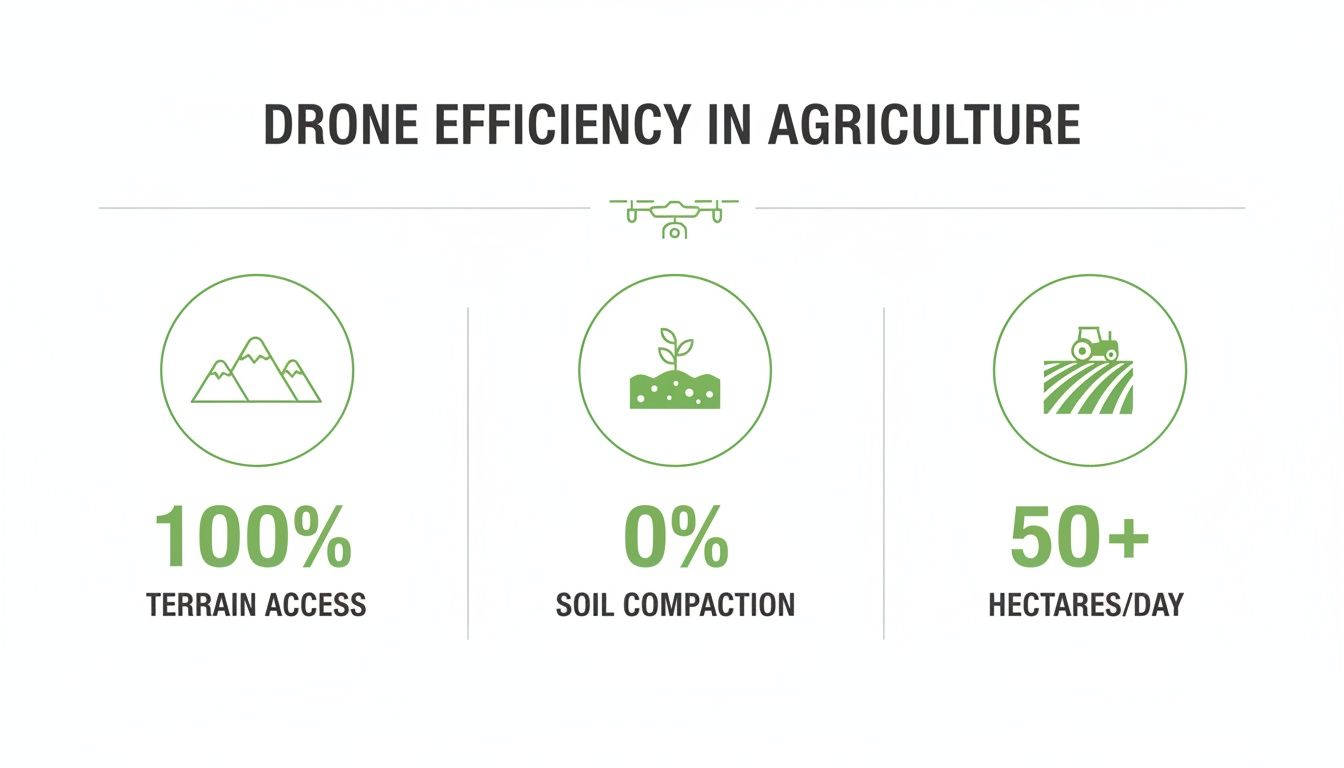
It is this ability to overcome physical barriers that allows for more precise and timely applications, which has a direct impact on your bottom line.
The Power of Uniform Droplet Atomisation
True precision extends beyond where the drone flies; it is also about how the spray is delivered. Advanced drones like the DJI AGRAS T50 are equipped with sophisticated technology for uniform droplet atomisation. This feature creates consistently sized droplets, ensuring even coverage across the entire plant canopy and maximising the effectiveness of every drop of pesticide, herbicide, or fertiliser. The downward thrust from the drone’s propellers provides another key advantage by gently pushing the fine mist deep into the plant canopy, coating both the top and underside of the leaves. This is particularly beneficial when controlling fungal diseases or pests hiding in dense foliage—a result that ground sprayers can often only achieve by drenching the crop entirely.
This level of control over droplet size and canopy penetration ensures that every dollar you spend on chemicals is working as hard as it possibly can. It’s a fundamental shift from volume-based application to performance-based application, delivering better results from less product.
For an orchardist, this means you can target a specific disease outbreak without spraying perfectly healthy trees. For a farmer, it means applying liquid nutrients only to the parts of a paddock showing deficiency. The result is a significant reduction in input costs and better protection for New Zealand’s precious waterways.
Spraying Method Comparison: Precision and Environmental Impact
This table compares key performance metrics between drone spraying and traditional ground and aerial methods, focusing on application accuracy, waste reduction, and environmental considerations for New Zealand conditions.
| Metric | Drone Spraying (e.g., DJI AGRAS T50) | Traditional Ground Spraying (Tractor) | Traditional Aerial Spraying (Helicopter/Plane) |
|---|---|---|---|
| Application Accuracy | Centimetre-level precision via RTK/GPS. | Meter-level accuracy, prone to overlaps/misses. | Lower accuracy, highly affected by wind and speed. |
| Spray Drift Risk | Very low due to controlled altitude and prop wash. | Moderate, influenced by boom height and wind. | High, significant risk of off-target drift. |
| Chemical Waste | Minimal; targets specific zones or plants. | Moderate to high from uneven application. | High due to broad coverage and drift. |
| Canopy Penetration | Excellent; prop wash pushes spray deep into foliage. | Fair; struggles to reach lower/inner leaves. | Poor to fair; mostly covers the top canopy. |
| Waterway Protection | High; precise control prevents runoff. | Moderate risk of runoff, especially on slopes. | High risk of contaminating nearby water sources. |
As you can see, drones offer a clear advantage in placing product exactly where it needs to go, which has major benefits for both your budget and the environment.
Real-World Savings for Kiwi Farmers
The financial impact of this precision is substantial. We have seen that traditional methods can easily apply 20-30% excess pesticides due to uneven boom coverage or drift. In contrast, drone spraying significantly reduces chemical usage from the outset. For our AgriUAS Limited clients in horticulture and orchards across Auckland and Waikato, using advanced drones like the DJI AGRAS T50 to target only affected areas cuts their input costs by 15-25%. That is a huge saving, especially in high-value export crops like kiwifruit and avocados where every dollar counts. You can find more insights on the use of drone technology at MG Group.
Cutting back on chemicals delivers more than just immediate cost savings:
- Environmental Stewardship: Less chemical runoff is vital for protecting our local ecosystems and waterways, which is a growing priority for NZ agriculture.
- Improved Crop Health: Avoiding over-application prevents plant stress and long-term soil health degradation.
- Enhanced Market Access: Being able to show sustainable and precise farming practices is a powerful advantage in competitive export markets.
Ultimately, the precision of drone spraying offers a direct and measurable return on investment. By using less to achieve more, you can boost your profitability while making your operation more sustainable for generations to come.
Looking at the Real Cost and Return on Investment
It is natural to look at new technology and focus on the price tag. However, when you examine the numbers, drone spraying makes clear financial sense for New Zealand farmers. To understand the value it delivers, you need to look beyond the simple hourly rate and consider the entire economic picture. A proper cost-benefit analysis includes not just the service invoice but also the significant savings you make on fuel, the reduced labour needed for difficult jobs, and the avoidance of wear and tear on heavy machinery. Each of these factors contributes to a healthier bottom line.
More Than Just an Upfront Cost
The initial quote for a drone service might appear similar to hiring a helicopter or running your own ground rig for a day. The real story, however, lies in the hidden savings that accumulate almost immediately. Traditional methods are known for their long list of associated costs—such as fuel, maintenance, and insurance for a tractor and boom sprayer—that simply do not apply with drones. These costs persist whether the machine is operating on flat, dry ground or consuming extra fuel in a wet, hilly paddock. For manned aircraft, the overheads are even higher, including pilot fees, hangar space, and significant fuel consumption. With a drone service, all these costs are bundled into one clear, predictable rate, which simplifies budgeting and financial planning.
A Real-World Scenario: Waikato Dairy Farm
Imagine a typical Waikato dairy farm with rolling hills, where some back paddocks become waterlogged after heavy rain. The farmer needs to apply liquid fertiliser, but the ground is far too soft for a tractor.
- Traditional Method: The farmer is forced to wait for the ground to dry out, potentially missing the optimal window for application. If they decide to risk it, driving a heavy tractor onto damp soil causes severe soil compaction, which stunts pasture growth and could cost thousands in lost productivity over time.
- Drone Method: A drone can get to work immediately, regardless of how wet the ground is. The job is completed quickly and precisely, with zero soil compaction. The farmer not only applies the fertiliser at the perfect time but also protects the long-term health and productivity of their pasture.
This is a perfect example of how drones do not just complete a task; they turn a potential loss into a productive gain. That represents a clear return on investment.
The true value isn't just in what the drone accomplishes, but in what it prevents. By avoiding soil compaction, protecting crop health, and ensuring you never miss an application window, drone spraying safeguards your farm's future profits.
When you look at the numbers, the cost savings of drone spraying over old-school methods in New Zealand are obvious. Hourly rates of $300-$600 deliver far more value by cutting down on fuel, labour, and machinery wear, especially on North Island farms where steep orchards and wet pastures make tractors slow and inefficient. In contrast, traditional spraying often means running large gear that burns up to 50% more fuel and needs two or three times the manpower for setup in hard-to-reach spots. Drones can be deployed fast, treating 10-20 hectares daily without causing the soil compaction that costs Kiwi farmers millions in lost productivity every year. You can learn more about these agricultural cost savings at SkyTech.
An Auckland Orchardist's Point of View
Now, let’s shift to a kiwifruit or avocado orchard in the Auckland region dealing with a localised fungal outbreak. In this high-value environment, precision is absolutely critical.
- Traditional Method: Using a large air-blast sprayer means treating the entire block, drenching healthy vines along with the affected ones. This wastes a significant amount of chemical, can stress the healthy plants, and increases the risk of environmental runoff.
- Drone Method: The drone is programmed to target only the specific rows or sections showing signs of disease. This surgical approach drastically reduces chemical use, often by 15-25%, which represents a massive saving on expensive fungicides. It also leads to better quality fruit, as the healthy plants are not needlessly sprayed.
In this situation, the return on investment comes from three distinct places:
- Lower Chemical Costs: Simple as that—using less product saves you money.
- Bigger Yields: Protecting healthy plants from chemical stress improves your overall fruit quality and volume.
- Better Marketability: Being able to show you’re using sustainable, precise methods is a great look for your brand.
The financial upside of drone spraying is not just theoretical. It is about practical, measurable gains that improve both your productivity and your farm's sustainability. Investing in this technology is a strategic move to boost the long-term financial health of your operation.
Improving Operator Safety and Reducing Labour Demands
Agriculture consistently ranks as one of New Zealand's most hazardous industries. Traditional spraying methods place operators in high-risk situations, from prolonged chemical exposure and the danger of tractor rollovers on unstable ground to the physical strain of manual application. Drone spraying fundamentally changes this dynamic by putting operator safety at the forefront. The most significant shift is that the operator is no longer in the immediate spray zone. A certified UAV pilot controls the entire mission from a safe distance, monitoring progress on a high-definition screen. This immediately eliminates direct contact with chemicals and removes the risk of accidents with heavy machinery on difficult hillsides or in boggy paddocks.
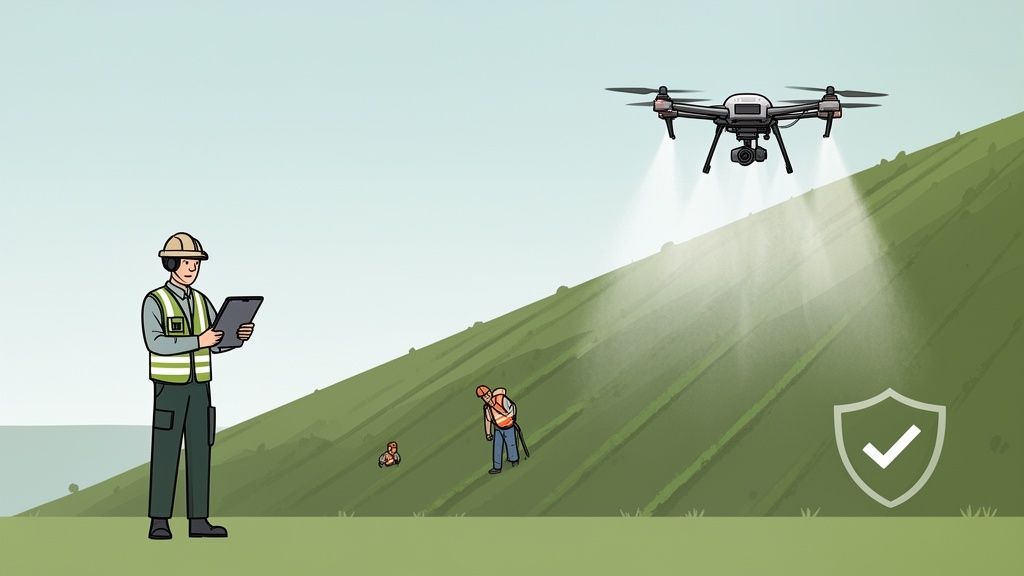
This approach transforms a physically demanding, high-risk job into a skilled, technology-focused role, protecting your most valuable asset: your people.
Reducing Physical Strain and Labour Intensity
Beyond preventing accidents, drone technology significantly reduces the physical toll on your team. Consider the task of controlling gorse on a steep hillside—a job that once required hours of carrying a heavy backpack sprayer can now be handled efficiently by a single drone operator.
This reduction in manual labour brings practical benefits for any farm or property manager:
- Minimised Worker Fatigue: Operators can cover far more ground without the physical burnout that can lead to costly mistakes and injuries.
- Improved Staff Retention: A safer, less physically draining work environment makes agricultural roles more appealing and helps retain good staff.
- Better Use of Resources: Key team members can be freed up for other important jobs while the drone takes care of the spraying, boosting overall operational efficiency.
This is especially true for challenging jobs like tackling gorse on steep Waikato hills or clearing vegetation along tricky fencelines. In these situations, traditional methods put workers in dangerous positions. A drone, however, completes the job with precision and zero risk to the operator. The same principle applies to specialised tasks such as roof spraying for commercial properties, where precision and safety are paramount.
A New Standard in Workplace Safety
Adopting drone spraying is not just about making work easier; it is about establishing a higher safety standard for New Zealand agriculture. By automating dangerous tasks, you create a much more controlled and predictable working environment.
"Drones significantly reduce the risk of applicators being contaminated by the pesticides, especially those using backpack sprayers." – Erdal Ozkan, Professor and Extension State Specialist, The Ohio State University
This expert insight highlights the core benefit. Instead of being in the line of fire, the operator becomes a mission controller, focusing on a precise and effective application from a secure location. This separation is crucial for long-term health, reducing the cumulative effects of chemical exposure over a career. Ultimately, integrating drone spraying is a forward-thinking move towards a safer, more sustainable, and less labour-intensive operation, demonstrating a commitment to caring for both your land and the people who work it.
Choosing the Right Spraying Method for Your Land
Integrating any new technology into your farming operation requires careful thought. While the benefits of drone spraying are clear, understanding exactly when to use it is the key to achieving the best results for your property. It is not about replacing every tool in your shed but about adding a highly specialised one that excels where other methods fall short. Making the right decision starts with assessing your specific challenges. Are you battling stubborn gorse patches in hard-to-reach gullies? Is wet ground constantly disrupting your spraying schedule? These are the exact situations where a drone transitions from being a novelty to an essential part of your land management strategy.
Identifying Ideal Scenarios for Drone Spraying
Drone spraying delivers its greatest value when precision, access, and care are top priorities. It is the perfect solution for jobs that are too difficult, dangerous, or intricate for ground rigs, and too small-scale for a helicopter or plane. It is all about matching the right tool to the job.
Consider calling in a drone when you are facing situations like these:
- Targeting Specific Weed Infestations: If you have patches of gorse, blackberry, or other invasive weeds on steep hillsides or along sensitive waterways, a drone can apply herbicide with surgical precision, leaving the surrounding pasture untouched.
- Managing Post-Rain Applications: When the ground is too waterlogged for a tractor, a drone can get to work straight away. This ensures you do not miss that critical window for applying fungicides or nutrients.
- Working in Environmentally Sensitive Zones: For jobs near streams, native bush, or against a neighbour's boundary, the drone’s ability to minimise spray drift is a massive advantage. It helps you remain compliant and protects the local ecosystem.
- Spot-Treating in High-Value Crops: In orchards or horticultural blocks, a drone can target specific rows or even individual plants showing signs of disease or pest pressure, saving you a fortune in wasted chemical.
For a deeper look at the gear that makes this all possible, you can learn more about the different types of agricultural spraying equipment available in NZ in our guide.
Partnering with a Certified Provider
The technology is only half of the story. The real value comes from partnering with a provider who combines UAV expertise with a solid understanding of agronomy. While any drone operator can fly, a true agricultural drone specialist knows what to apply, when to apply it, and how to achieve the best results for your specific land or crop.
Choosing a partner like AgriUAS means you’re not just hiring a drone; you’re bringing in a specialist who gets the unique challenges of New Zealand farming. This blend of technical skill and practical knowledge is what delivers a better outcome.
We work with you to understand your goals, assess your terrain, and develop a spraying plan that completes the job with quality and care. This partnership approach ensures you get the most from every application, boosting your productivity and protecting your land for the future.
Common Questions About Drone Spraying
As farmers and landowners across New Zealand explore drone technology, a few practical questions often arise. It is one thing to hear about the benefits, but another to understand how it actually works on your land. We understand. Here are some straightforward answers to the queries we hear most often from our clients in Auckland, Waikato, and around the North Island.
How Much Area Can a Drone Spray in a Day?
The daily coverage really depends on the specific job, including the terrain, the product we are applying, and the size of the target area. For precise spot spraying, such as targeting patches of gorse on a steep Waikato hillside, a drone can efficiently cover 10 to 20 hectares per day. However, for more widespread applications like spraying liquid fertiliser over a flat, open paddock, that number can increase significantly. The key advantage here is not just raw speed but smart efficiency. Drones launch directly from the paddock edge, eliminating the travel time to and from a distant airstrip, which means more of the day is spent applying product and getting the job done.
Are Drones Effective in Windy Conditions?
That is a fair question, especially for farming in New Zealand where the wind can be unpredictable. Although drones are lighter than planes or helicopters, they are incredibly stable. Modern agricultural drones like the DJI AGRAS T50 are designed to handle moderate wind conditions safely and effectively. Their greatest advantage is their low operating altitude. By flying just a few metres above the crop, the drone largely avoids the stronger winds found higher up. Furthermore, the downward thrust from the propellers actively pushes the spray into the target foliage, helping to minimise off-target drift far more effectively than high-altitude aerial spraying.
What Qualifications Do Drone Operators Need?
Flying an agricultural spray drone in New Zealand is a highly regulated and skilled profession. A professional and legal drone spraying provider must hold specific certifications.
A fully qualified pilot will have:
- Civil Aviation Authority (CAA) Part 102 Certification: This is the non-negotiable legal requirement for operating drones for agricultural work in New Zealand.
- Growsafe Certification: This demonstrates that the operator knows how to handle and apply agricultural chemicals safely, responsibly, and effectively.
- Specialised UAV Training: Pilots also complete intensive training on the specific drone models they operate, covering everything from flight planning and precision application to emergency procedures.
This combination of aviation skill and agricultural knowledge ensures every job meets the highest standards of safety and quality. When you choose a certified provider, you can have peace of mind knowing the application is not only effective but also fully compliant with New Zealand law.
Ready to see how the benefits of drone spraying over traditional methods can transform your land management? The team at AgriUAS Limited is here to provide a precise, efficient, and cost-effective solution tailored to your specific needs. Contact us today for a consultation.